Join
Join
 Shorts

A Toyota badge usually feels like a warm handshake from your practical uncle.
Reliable? Usually.
Fuel-efficient? Almost always.
Drama-free? That’s the dream.
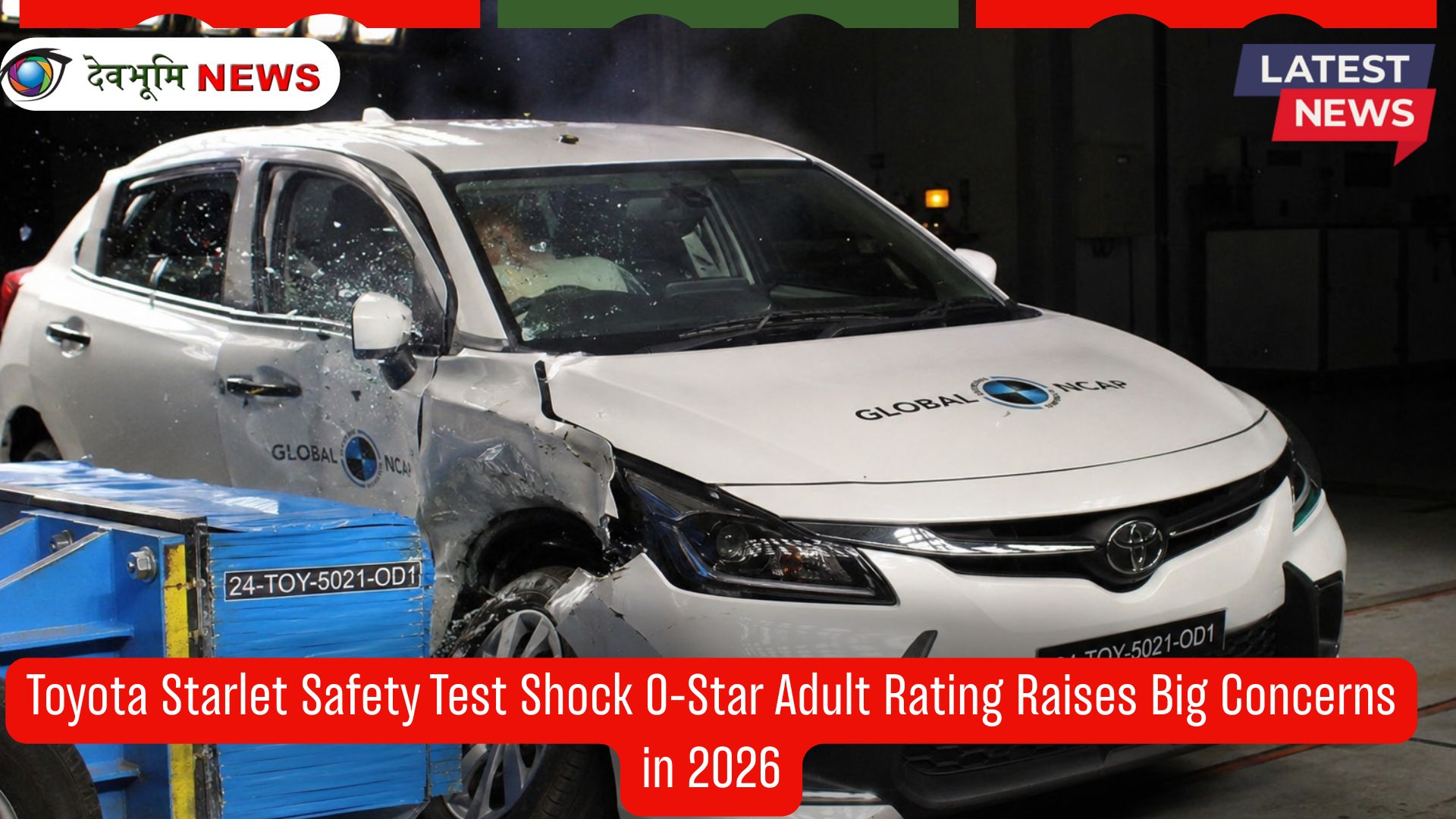
So when the Toyota Starlet safety test landed with a 0-star adult occupant rating from Global NCAP, it felt less like a routine report and more like someone dropping a wrench into the gearbox of Toyota’s reputation.
But before the internet turns this hatchback into the automotive equivalent of a villain origin story, there’s an important nuance:
The 0-star score applies only to Adult Occupant Protection (AOP).
For Child Occupant Protection (COP), the Starlet actually scored a respectable 3 stars.
So no, it wasn’t a total collapse—just a very public stumble in the adult safety department.
Toyota Starlet Safety Test Results Explained
The India-made Toyota Starlet, tested under Global NCAP’s Safer Cars for Africa campaign, delivered mixed results:
Official Scores
| Category | Score |
|---|---|
| Adult Occupant Protection | 0 Stars (0/34 points) |
| Child Occupant Protection | 3 Stars (29.33/49 points) |
That score split is unusual enough to make engineers raise eyebrows.
It’s like getting an F in calculus but somehow pulling a B in literature.
Concerning, but oddly specific.
Why Did the Toyota Starlet Score 0 Stars for Adults?
The headline-grabbing zero wasn’t primarily caused by the frontal crash.
That’s the important detail many summaries miss.
Frontal Offset Crash Performance: Surprisingly Decent
In the frontal offset test:
- Driver head and neck protection: Good
- Passenger head and neck protection: Good to Adequate
- Driver and passenger chest protection: Adequate
So the frontal result wasn’t catastrophic.
Not brilliant, but not “run for the hills” either.
The Real Problem: Side Impact Performance
The real disaster unfolded during the side barrier impact test.
This is where the Starlet’s adult safety score effectively hit a wall—quite literally.
Side Impact Results
- Head protection: Poor
- Chest protection: Poor
That severe side-impact vulnerability is what dragged the adult score to 0/34 points.
In crash-test terms, this is less “minor deduction” and more “the examiner put the red pen through the desk.”
Child Safety Was Actually Moderate, Not Terrible
This is where the narrative gets more balanced.
The Toyota Starlet safety test showed a 3-star child occupant rating, scoring 29.33/49 points.
Child Protection Breakdown
- 18-month-old dummy: Good overall protection
- 3-year-old dummy: Head made contact with vehicle interior during side impact
That contact issue prevented a stronger score, but overall performance wasn’t disastrous.
Parents won’t exactly throw confetti over 3 stars, but it’s far from the all-round safety collapse some headlines imply.
Safety Features Included in the Tested Toyota Starlet
The tested Starlet was not stripped bare.
It included several standard safety features:
- Dual front airbags
- ABS
- ISOFIX child seat anchors
- Electronic Stability Control (ESC)
Notably, ESC was standard and rated acceptable by Global NCAP.
So blaming missing stability control would be inaccurate.
That feature did its job.
Quietly, like a referee nobody notices unless something goes wrong.
What Was Missing? The Side Airbag Problem
The critical weakness was the absence of:
- Side head airbags
- Curtain airbags
This omission had major consequences.
Without side head protection, Global NCAP could not even conduct the side pole impact test.
That’s not ideal.
It’s like showing up to a chess tournament missing half your pieces and still hoping for strategic praise.
“Outgoing Model” Doesn’t Mean Old Generation
A common misunderstanding is that this is some ancient leftover model.
Not quite.
The tested vehicle belongs to the current liquid-flow design generation.
The “outgoing” label refers specifically to the older 2-airbag equipment specification.
That distinction matters.
Because during the testing and shipping period, Toyota South Africa updated the Starlet’s standard equipment to include:
- 6 airbags as standard
- Side head airbags
- Curtain airbags
This upgraded model is already on sale.
Toyota’s Response: A Re-Test Is Already Underway
Here’s the twist in the story.
Global NCAP has already anonymously purchased the updated 6-airbag Toyota Starlet for a fresh round of testing.
That means this story may have a sequel.
And unlike most sequels, this one could actually be better.
A significantly improved rating is now entirely possible.
Which makes the current 0-star result feel less like a final verdict and more like an awkward screenshot from an update patch before version 2.0 dropped.
Should Buyers Avoid the Toyota Starlet?
Not necessarily.
But buyers should understand exactly what version they’re considering.
If buying:
Older 2-airbag specification
- Be cautious
- Adult side-impact safety is the major concern
If buying:
New 6-airbag specification
- Wait for updated crash-test results
This is one of those rare cases where timing matters almost as much as trim level.
Buying the wrong spec could mean purchasing yesterday’s problem at today’s price.
Read more
- Avatar Fire and Ash Release Date 2026: Confirmed Disney+ & Blu-ray Update
- Trump- Xi Summit 2026: Donald Trump and Xi Jinping Hold High- Stakes Beijing Talks Amid Taiwan and Iran Pressures
- BRICS Foreign Ministers’ Summit 2026: Jaishankar Says West Asia Conflict Deserves Particular Attention
Final Verdict: Toyota Starlet Safety Test Is a Lesson in Reading Beyond Headlines
The Toyota Starlet safety test is a reminder that crash-test headlines can oversimplify complex results.
Yes, the car scored:
- 0 stars for adult safety
But also:
- 3 stars for child safety
- acceptable frontal crash performance
- standard ESC, ABS, ISOFIX, and dual airbags
The real issue was side-impact vulnerability caused largely by missing side and curtain airbags in the tested 2-airbag spec.
That’s serious—but it’s also something Toyota appears to have already addressed with the new 6-airbag version.
So this isn’t quite a story of catastrophic failure.
It’s a story of a manufacturer getting caught mid-transition.
A public lesson in how automotive safety evolves faster than headlines.
And perhaps the biggest reminder of all:
Cars aren’t just about horsepower, touchscreen sizes, or whether the ambient lighting can mimic a nightclub.
Sometimes, the most important feature is the one you hope you never need.