Join
Join
 Shorts


India has joined the United States and 24 other countries in a major international initiative aimed at shaping the development and deployment of next-generation 6G telecommunications networks. The move places India among a group of 26 governments seeking to influence the technological, security and strategic architecture of future wireless communication systems.
The announcement was made by the US Department of Commerce following a bilateral meeting between US Commerce Secretary Howard Lutnick and India’s Minister of State for Commerce and Industry Jitin Prasada on the sidelines of the G20 Innovation Ministerial. The initiative is aimed at ensuring that future 6G networks reflect shared security interests, strengthen technological competitiveness and encourage innovation.
India’s participation is significant because 6G is expected to go far beyond simply offering faster mobile internet. The technology is likely to integrate artificial intelligence, advanced sensing, computing, robotics, satellite connectivity and highly automated network management. Countries that help shape its standards and underlying technologies could gain considerable economic and strategic advantages.
What is the US-led 6G initiative?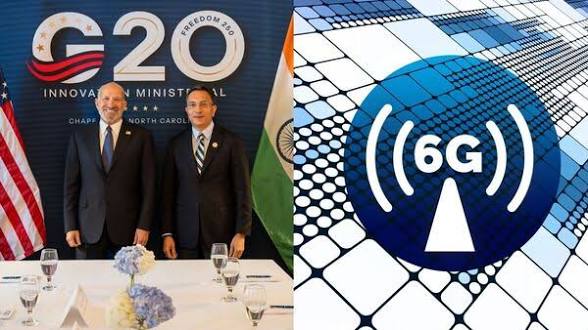
The international initiative focuses on cooperation among participating countries to influence how next-generation networks are designed, secured and deployed. Key concerns include network security, interoperability, resilience, trusted technology supply chains and technological competitiveness.
The initiative comes at a time when governments around the world are beginning to compete over the future architecture of 6G. Although widespread commercial deployment remains years away, research, patents and standards development are already underway.
For India, participation provides an opportunity to ensure that its technological interests are represented in international discussions at an early stage.
India-US talks go beyond 6G
The announcement followed discussions between Jitin Prasada and Howard Lutnick on the sidelines of the G20 Innovation Ministerial. The two sides discussed cooperation in several strategic technology sectors, including semiconductors, artificial intelligence and data centres, apart from 6G.
Prasada also encouraged greater US investment under India’s semiconductor programme, while discussions included strengthening the AI technology partnership and developing safeguards for artificial intelligence.
These discussions indicate that India’s technology cooperation with the US is increasingly expanding beyond conventional trade and investment into strategic digital infrastructure and emerging technologies.
India already has its own 6G ambitions
India’s participation in the international initiative complements its domestic Bharat 6G Mission. The government has been working to build an ecosystem involving telecom companies, equipment manufacturers, startups, universities and research institutions.
The Bharat 6G Alliance had expanded to 90 members by July 2026, according to the Ministry of Communications. The alliance includes telecom service providers, equipment manufacturers, startups, academic institutions and research organisations. It has also created working groups covering 6G technologies, spectrum, applications, devices, components, sustainability and other areas.
The government has said that the alliance is intended to strengthen India’s domestic research, innovation and intellectual-property ecosystem while helping develop proposals for advanced testbeds and research.
Focus on security and interoperability
One of the most important aspects of the emerging 6G debate is security. Future networks are expected to connect not only smartphones but also autonomous vehicles, industrial machines, healthcare systems, smart infrastructure and potentially critical national systems.
Any vulnerability in such networks could therefore have consequences far beyond disrupted mobile services.
India has previously supported international principles calling for future 6G networks to be trusted and secure, resilient and reliable, open and interoperable, inclusive and affordable, and sustainable. These principles were endorsed through the New Delhi Declaration associated with the Bharat 6G Symposium.
India’s participation in the latest US-led initiative could therefore help align its domestic 6G strategy with broader international discussions on security and interoperability.
Race for 6G leadership
The global race for 6G leadership is already taking shape. Governments and technology companies are investing heavily in research into advanced radio technologies, artificial intelligence-driven networks, satellite integration, sensing and ultra-low-latency communication.
India has also set ambitious targets for increasing its contribution to global 6G intellectual property. The government has previously stated an aspiration to secure a 10% share of global 6G patents.
Participation in international technology initiatives could help Indian researchers and companies gain greater visibility and opportunities for collaboration.
Potential economic benefits
The transition to 6G could create opportunities across multiple industries. Telecom equipment, semiconductors, software, artificial intelligence, cloud computing, robotics and advanced manufacturing are all expected to benefit from the development of next-generation networks.
For India, the economic opportunity is particularly important because the country wants to move from being primarily a large consumer of telecommunications technology to becoming a producer of technologies, intellectual property and equipment.Greater international cooperation could also help Indian companies participate in global supply chains and technology partnerships.
Strategic importance for India
The decision to join the initiative also has a wider geopolitical dimension. Telecommunications networks are increasingly regarded as strategic infrastructure, and countries want trusted suppliers and secure technology ecosystems.
By participating in the US-led framework while simultaneously developing its own Bharat 6G ecosystem, India can seek to balance international cooperation with domestic technological capability.
The government is also pursuing parallel partnerships in AI, semiconductors, robotics and digital public infrastructure, making 6G part of a broader technology strategy rather than an isolated telecommunications project.
Read more like this:
- SBI की बड़ी भर्ती योजना: FY27 में 12 हजार कर्मचारियों की होगी नियुक्ति, 250 नई शाखाएं खोलने की तैयारी
- एक्सपोर्ट बिजनेस में क्रेडिट इंश्योरेंस क्यों है जरूरी? जानिए इसके बारे में सबकुछ!
- स्वच्छ वायु सर्वेक्षण 2026 में लखनऊ नंबर-1, इंदौर दूसरे और जबलपुर तीसरे स्थान पर
The road ahead
India’s participation does not mean that 6G services will become available immediately. The technology is still in the research, development and standardisation phase. Much work remains to determine technical standards, spectrum requirements, security frameworks, equipment architecture and commercial applications.
For India, however, joining the initiative at this stage means having a seat at the table while these rules are being shaped.
Conclusion
India’s entry into the US-led initiative involving the United States and 24 other countries represents an important step in New Delhi’s efforts to influence the future of global telecommunications. The partnership is focused on creating next-generation networks that are secure, competitive, interoperable and innovation-driven.
At the same time, India is strengthening its domestic capabilities through the Bharat 6G Alliance and its wider 6G mission. The combination of international cooperation and domestic research could help India play a larger role in defining the technology standards, intellectual property and security architecture of the 6G era.
As the global race for next-generation connectivity accelerates, India’s challenge will be to convert participation in international forums into tangible outcomes—more research, stronger patents, indigenous technologies, manufacturing capacity and globally competitive Indian companies.