Join
 Shorts

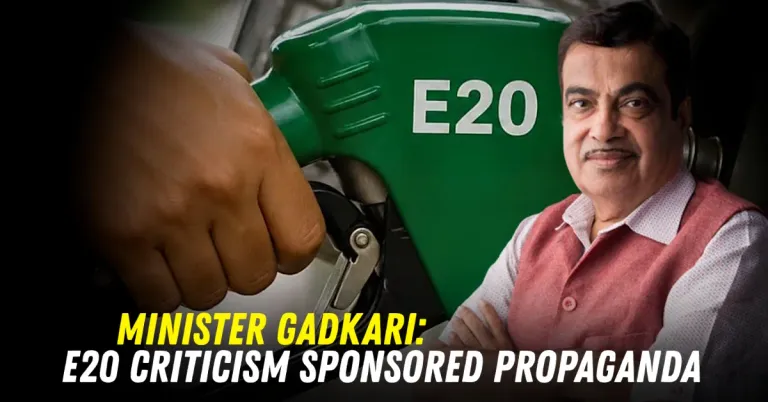
Union Minister for Road Transport and Highways Nitin Gadkari has defended the government’s ethanol-blending programme, dismissing criticism of E20 petrol as propaganda. E20 is a fuel containing 20% ethanol blended with 80% petrol. The government has promoted ethanol as an alternative fuel to reduce dependence on imported crude oil, support farmers and lower carbon emissions.
Gadkari’s remarks have renewed the debate over India’s fuel policy, vehicle compatibility, consumer concerns and the country’s transition towards cleaner energy. While supporters consider ethanol an important step towards energy independence, critics have raised questions about fuel efficiency, engine performance and the long-term impact on vehicles.
What Is E20 Fuel?
Understanding Ethanol Blending
Ethanol is an alcohol-based fuel that can be produced from agricultural feedstocks such as sugarcane, maize and other suitable biomass. Under the E20 programme, ethanol is blended with petrol at a concentration of 20%.
India has gradually increased ethanol blending in petrol as part of its broader strategy to diversify energy sources. The programme also aims to create additional demand for agricultural products and strengthen the domestic biofuel industry.
Why Is the Government Promoting E20?
India imports a significant proportion of its crude oil requirements, making its economy vulnerable to fluctuations in international oil prices. Increasing ethanol blending can help reduce the amount of petrol required from fossil-fuel sources.
The government also sees ethanol as an opportunity to improve farmers’ incomes, create rural employment and encourage investment in biofuel production facilities.
Gadkari Defends the Ethanol Programme
Rejecting Criticism as Propaganda
Gadkari has strongly defended ethanol blending against criticism and has argued that alternative fuels are essential for India’s long-term economic and environmental interests.
His position reflects the government’s broader effort to reduce reliance on conventional fossil fuels. According to supporters of the programme, ethanol blending can provide economic benefits while helping India diversify its energy mix.
However, concerns about E20 should be assessed through technical evidence, independent testing and real-world vehicle performance rather than political arguments alone. The precise context of Gadkari’s quoted remark is important when interpreting what he meant by describing the criticism as propaganda.
Major Benefits of E20 Petrol
Reducing Dependence on Imported Oil
One of the principal objectives of ethanol blending is to reduce petrol consumption derived from imported crude oil. Greater domestic production of ethanol can improve energy security and reduce exposure to international oil-market disruptions.
The actual reduction in imports depends on ethanol production, feedstock availability, blending levels and overall fuel demand.
Supporting Farmers and Rural Industries
Ethanol production creates a market for agricultural commodities, particularly sugarcane and maize. It can also generate opportunities for distilleries, transport operators and rural processing industries.
If managed responsibly, the programme could support agricultural diversification and provide additional income opportunities for farmers. Nevertheless, policymakers must also consider water consumption, food security and the environmental impact of growing fuel crops.
Environmental Advantages
Ethanol can offer lower lifecycle greenhouse-gas emissions than conventional petrol, depending on how it is produced and transported. Its environmental benefits are therefore influenced by farming practices, processing methods, electricity sources and the feedstock used.
E20 is not entirely emission-free, but it may contribute to reducing the overall carbon footprint of transport when supported by sustainable production practices.
Challenges and Concerns Surrounding E20
Mileage and Vehicle Compatibility
One of the main concerns among motorists is the possibility of reduced fuel efficiency. Ethanol contains less energy per litre than petrol, which can result in lower mileage in some vehicles, particularly those designed for lower ethanol blends.
Government statements have acknowledged that certain vehicles designed for E10 may experience a fuel-economy reduction of around 3–5%. However, the impact varies according to vehicle design, driving conditions and maintenance.
The Need for Consumer Awareness
Vehicle owners should check their manufacturer’s fuel-compatibility guidance before using higher ethanol blends. Clear information about mileage expectations, maintenance requirements and warranty conditions can help consumers make informed decisions.
Transparent communication and independent testing will be essential to maintaining public confidence in the programme.
Gadkari’s Push for Alternative Fuels
Beyond Ethanol: Hydrogen, CBG and Bio-Bitumen
Gadkari’s vision extends beyond ethanol-blended petrol. He has also advocated compressed biogas (CBG), hydrogen-powered vehicles, bio-bitumen and materials produced from waste.
These technologies could help reduce India’s dependence on imported fossil fuels while creating new business opportunities in agriculture, transport, infrastructure and manufacturing.
He has argued that farmers should become producers of energy and industrial raw materials rather than depending exclusively on traditional agricultural markets. Such a transition could strengthen rural economies and encourage investment in new technologies.
Read more like this:
- कर्नाटक MLC चुनाव: BJP के नेतृत्व वाले NDA ने जीतीं सभी 4 सीटें, डीके शिवकुमार को बड़ा झटका
- India Weighs US-Style Frontier AI Safeguards As Government Prepares New Law
Conclusion
Nitin Gadkari’s defence of E20 highlights the government’s determination to promote alternative fuels as part of India’s energy strategy. Ethanol blending offers potential benefits, including reduced dependence on imported oil, additional markets for agricultural products and lower lifecycle emissions when production is sustainable.
At the same time, concerns about mileage, compatibility and consumer costs deserve clear, evidence-based responses. The success of E20 will depend not only on government policy but also on technological improvements, responsible production and public trust.
India’s broader transition towards ethanol, hydrogen, CBG and other alternative fuels could reshape its energy landscape. The ultimate goal should be to achieve energy security and environmental sustainability without placing an unreasonable burden on consumers.