Join
Join
 Shorts

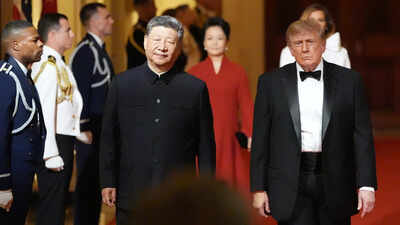
US President Donald Trump and Chinese President Xi Jinping met at the White House amid efforts to stabilise relations between the world’s two largest economies. Trade, Taiwan, artificial intelligence and strategic competition dominated the discussions, but major differences remain unresolved.
US President Donald Trump and Chinese President Xi Jinping struck a relatively conciliatory tone during their White House meeting on Thursday, even as Washington and Beijing remain divided over trade, technology, Taiwan and broader geopolitical issues.
Xi called for the two countries to treat their rivalry as a “race” rather than a confrontation, while Trump highlighted his relationship with the Chinese leader and described their ties in positive terms. However, the meeting produced limited concrete breakthroughs on some of the most difficult issues confronting the two countries.
Here are five key takeaways from the summit.
1. Trade truce gets another extension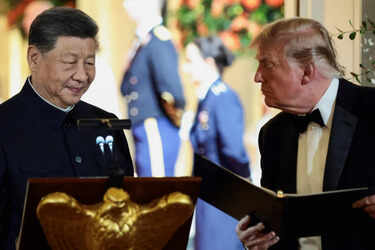
One of the clearest outcomes was an extension of the existing US-China trade truce by two months. The arrangement had been due to expire in November, giving negotiators additional time to work on a broader economic understanding.
US Treasury Secretary Scott Bessent said the extension would provide Washington and Beijing with more time to make progress. However, major questions remain, including tariffs, Chinese purchases of American goods, rare-earth supplies and US restrictions on advanced technologies.
The short extension therefore provides temporary breathing room rather than resolving the underlying trade dispute.
2. Xi wants competition without confrontation
Xi Jinping used the summit to argue that competition between the US and China does not have to become a zero-sum struggle.
He referred to the so-called “Thucydides Trap”, a theory that rivalry between an established power and a rising power can increase the risk of conflict. Xi said the two countries should instead pursue “healthy” competition and described the relationship as a race in which both sides can try to advance without turning the contest into a physical confrontation.
He also called for regular military communication and stronger mechanisms to prevent crises from escalating.
For Washington and Beijing, such communication is particularly important because disagreements now extend well beyond tariffs and commercial issues.
3. Taiwan remains a major fault line
Taiwan continues to be one of the most sensitive issues in US-China relations.
During the discussions, Xi urged Washington to handle the Taiwan question with caution and expressed Beijing’s opposition to Taiwan independence, according to Chinese state media reports.
The issue remains complicated because the United States has long maintained a policy designed to deter conflict while avoiding a formal commitment to support Taiwan independence. China, meanwhile, regards Taiwan as part of its territory and strongly opposes moves toward formal independence.
There was no indication from the summit that the fundamental differences over Taiwan had been resolved.
4. AI is becoming the next major battleground
Artificial intelligence emerged as another central area of competition.
Xi said the US and China have a responsibility to ensure that AI development remains under human control and serves public welfare. He also advocated greater dialogue between the two countries on managing the technology.
Trump has taken a different emphasis, focusing strongly on maintaining US technological leadership and competing with China in advanced AI.
The two countries are simultaneously trying to expand their own AI ecosystems while imposing restrictions around sensitive technologies, particularly advanced chips. That makes AI both an economic opportunity and a national-security issue.
5. The rivalry is bigger than trade
The summit demonstrated how broad the US-China relationship has become. In addition to trade, Taiwan and AI, the two countries face disagreements over Iran, strategic technology, rare-earth minerals and global influence.
At the same time, the economic relationship remains deeply interconnected. US financial institutions and investors continue to have significant exposure to Chinese technology markets, while Chinese companies and investors remain connected to global capital and supply chains.
This combination creates a complicated situation: Washington and Beijing are competitors in strategic sectors but remain economically linked.
Read more like this:
- ‘You will be handed a few wins’: SIR विवाद के बीच अभिजीत दीपके ने विपक्ष से कहा- चुनाव लड़ना बंद करें
- CEC ज्ञानेश कुमार के खिलाफ सुप्रीम कोर्ट में याचिका दायर, SIR में गड़बड़ी पर SIT जांच की मांग
A pause, not an end to rivalry
The Trump-Xi meeting appears to have created space for further negotiations rather than resolving the fundamental disagreements between the two governments.
The two leaders’ relatively warm public tone, combined with the extension of the trade truce, may reduce the immediate risk of another escalation. But tariffs, technology controls, Taiwan, rare-earth supplies and AI governance remain unresolved.
Xi’s “race, not wrestle” message captures the broader challenge facing both governments: how to compete intensely while maintaining enough communication to prevent competition from turning into confrontation.
For now, the summit has kept dialogue open. Whether that dialogue can produce a more durable framework for US-China relations will depend on the negotiations that follow.