Join
Join
 Shorts

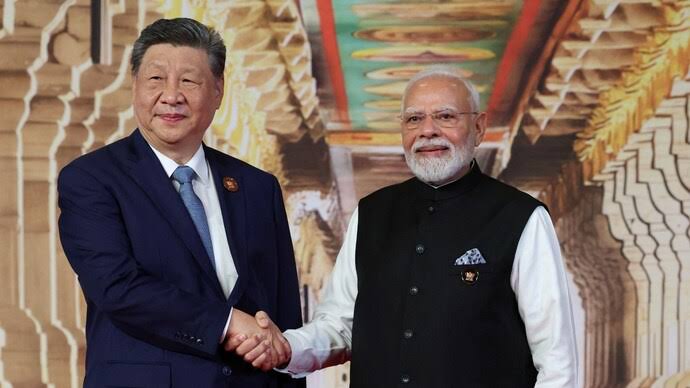
Chinese President Xi Jinping has called on the BRICS grouping to play a more active role in efforts to end the ongoing war in West Asia, saying that the conflict does not serve the common interests of the international community. Speaking at the BRICS Summit in New Delhi on Saturday, Xi said China was prepared to work with other BRICS members to help find a peaceful solution to the crisis.
Xi’s remarks came against the backdrop of continuing instability in West Asia, where the conflict has created wider geopolitical, humanitarian and economic concerns. The Chinese president’s appeal also placed the spotlight on the expanding BRICS grouping and its potential role in addressing major international crises.
Xi calls for a peacemaking role for BRICS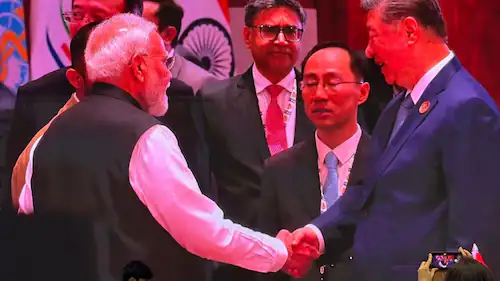
According to Chinese state broadcaster CCTV, Xi said the BRICS countries should act as a force for peace and contribute to efforts aimed at resolving the conflict. He argued that the continuation of war was not in the common interest of the international community.
The Chinese president also said Beijing was ready to cooperate with other BRICS members in pursuing diplomatic efforts. His statement suggested that China wants the expanded grouping to move beyond economic cooperation and assume a more visible role in discussions on global peace and security.
Xi’s intervention is significant because BRICS now includes countries with differing positions and interests on the West Asia conflict. Bringing these countries together around a common diplomatic position could therefore be both an opportunity and a challenge for the grouping.
BRICS Summit takes place amid global conflicts
The 2026 BRICS Summit is being held in New Delhi, with Indian Prime Minister Narendra Modi hosting leaders from the expanded grouping. The summit has taken place amid multiple international crises, including the continuing conflict in West Asia and the war in Ukraine.
The gathering has brought together leaders including Xi Jinping, Russian President Vladimir Putin and Iranian President Masoud Pezeshkian, alongside leaders and representatives from other BRICS nations. The presence of Iran gives the West Asia conflict particular significance at the summit.
BRICS has expanded considerably since its original formation by Brazil, Russia, India and China, with South Africa joining later and several additional members being admitted in recent years. The enlarged grouping represents a substantial share of the world’s population and economy.
China wants BRICS to strengthen its Global South role
In his address, Xi described BRICS as a leading grouping within the Global South. He also presented the bloc as a model of self-reliance and cooperation among emerging and developing countries.
Xi’s comments indicate that China sees BRICS as an increasingly important platform for countries seeking a greater role in global decision-making. Beijing has repeatedly advocated a more multipolar international system and greater representation for developing countries in global institutions.
At the New Delhi summit, however, BRICS members are also discussing practical economic issues such as trade, investment, energy security, food security, technology and financial cooperation.
West Asia conflict poses economic risks
The war in West Asia is not only a security and humanitarian issue but also has significant implications for the global economy. The region is crucial to international energy supplies and shipping routes.
Recent tensions have pushed oil prices higher, with global crude prices reaching around $108 per barrel, while disruptions and threats to shipping routes have increased concerns over energy supplies and international trade.
For countries such as India and China, which are major energy consumers, prolonged instability in the region could create additional economic pressures. Higher energy prices can increase transportation and production costs and contribute to inflation.
The conflict also affects shipping through strategically important waterways. Any prolonged disruption could have consequences for supply chains far beyond West Asia.
India’s balancing role
Xi’s comments also come at a significant moment in India-China relations. The Chinese president is visiting India for the first time in seven years, and his participation in the BRICS Summit has attracted considerable attention.
India and China have experienced serious tensions since the 2020 Galwan Valley clash. However, relations have gradually moved toward a cautious thaw in recent years, including progress on border disengagement and renewed diplomatic and economic engagement.
Prime Minister Narendra Modi and Xi Jinping are also expected to hold bilateral discussions on the sidelines of the summit. Their engagement comes as both countries attempt to stabilize ties while continuing to manage unresolved strategic differences.
For India, the BRICS platform offers an opportunity to maintain dialogue with China, Russia and Iran while simultaneously preserving its strategic relationships with the United States, Europe and other partners.
BRICS faces internal difference
Despite Xi’s call for a stronger peace role, the expanded BRICS grouping is not a politically uniform alliance. Its members have different strategic priorities, economic interests and positions on international conflicts.
India has emphasized that BRICS should not become an anti-Western bloc but should instead provide a platform for cooperation among emerging and developing economies. The summit is therefore testing whether BRICS can accommodate different political positions while still producing meaningful common initiatives.
The West Asia conflict is particularly sensitive because BRICS includes countries directly affected by the crisis and countries with different relationships with the parties involved.
China to chair BRICS next year
Xi also announced that China will assume the BRICS chairmanship next year and host the 19th BRICS Summit.
The announcement gives Beijing an opportunity to shape the group’s agenda during the next phase of its expansion. Issues such as global governance reform, economic cooperation, local-currency trade, technology and international security are likely to remain important.
China’s expected leadership role could also provide greater space for Beijing to promote its vision of a more multipolar world order.
Read more like this:
- AI Could Kill All Humans in the Next Decade, Warn Experts: How Seriously Should We Take Them?
- BRICS Declaration Unlikely to Name Any Nation, But Bloc Set to Condemn Unilateral War
- NMC Adds Over 13,000 MBBS Seats, Total Intake Crosses 1.4 Lakh
What Xi’s statement means
Xi’s call for BRICS to become a peacemaker represents an attempt to position the grouping as more than an economic forum. If BRICS members can develop a coordinated diplomatic approach, the bloc could strengthen its influence on major global crises.
However, achieving consensus will not be easy. The members have divergent national interests, and their positions on West Asian security are not identical.
For India, the summit provides an opportunity to support dialogue and de-escalation without becoming part of any military or geopolitical camp.
Conclusion
Chinese President Xi Jinping’s message at the New Delhi BRICS Summit has placed peace and diplomacy in West Asia at the centre of the grouping’s wider global role. His assertion that the war does not serve the common interests of the international community reflects China’s push for a diplomatic solution and a more prominent role for BRICS in global affairs.
The statement also comes at a strategically important time, with Xi visiting India after seven years and India-China relations showing signs of cautious improvement.
Whether BRICS can convert Xi’s call for peace into a coordinated diplomatic initiative will depend on the ability of its diverse members to overcome their differences. For now, the New Delhi summit has demonstrated that West Asia’s conflict is no longer only a regional issue—it is increasingly shaping the agenda of major Global South forums such as BRICS.