Join
 Shorts


The Supreme Court of India has made an important observation regarding consensual physical relationships between adults, stating that sexual intimacy cannot be retrospectively termed rape merely because a relationship later breaks down. The court expressed concern over the increasing tendency to convert failed relationships into criminal cases. It emphasised that the law must distinguish between genuine sexual offences and disputes arising from personal relationships.
The observation highlights the importance of consent, individual freedom and the proper use of criminal law. It also reinforces the principle that the failure of a relationship does not automatically make earlier consensual acts criminal.
Background of the Case
The Dispute Involving a Kerala Resident
The Supreme Court made these observations while hearing an appeal filed by Santosh Kumar N. P., a resident of Kerala, who was facing charges of rape, cheating and other offences.
According to the complainant, the accused had concealed the fact that he was already married and had entered into another marriage with her while his first marriage was still subsisting. The woman alleged that she agreed to physical relations because she believed that their marriage was legally valid.
The woman, who was previously divorced, claimed that the accused had deceived her regarding his marital status. The two reportedly married in Mysuru and lived together between 1996 and 2003.
However, the court noted that the woman had become aware of the accused’s earlier marriage within a few months of beginning their life together. Despite this knowledge, the relationship continued for several years.
Supreme Court’s Important Observations
Consent Cannot Be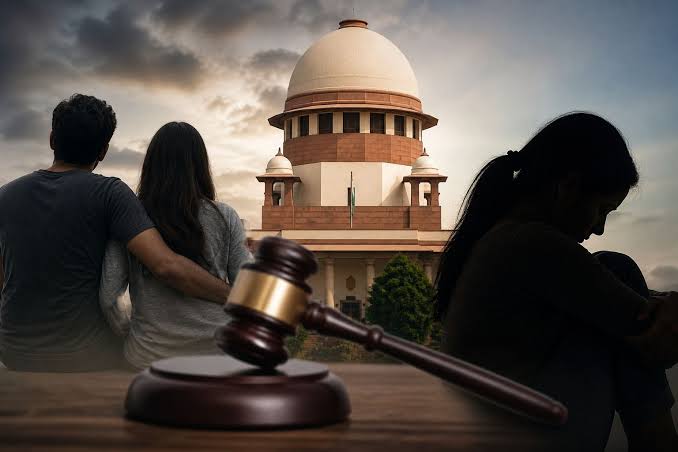 Reconsidered Merely Because of a Breakup
A bench comprising Justice B. V. Nagarathna and Justice R. Mahadevan observed that physical intimacy during a functioning and consensual relationship cannot later be branded as rape simply because the relationship has become unpleasant or has ended.
The court pointed out that there is a significant difference between consent obtained through deliberate deception from the beginning and regret arising after a relationship fails.
It observed that the criminal justice system should not be used to punish individuals merely because a personal relationship did not produce the expected outcome.
Right to End a Relationship
The Supreme Court also emphasised that every adult has the freedom to make personal decisions, including the decision to enter into or withdraw from a relationship.
The bench questioned whether a person could be accused of deceit or fraud simply for deciding to leave a relationship. It made clear that ending a consensual relationship cannot, by itself, constitute a criminal offence.
The court also stated that criminal law must not become a weapon for settling personal scores, taking revenge or pressuring another individual.
Difference Between Consent and Deception
When Can Consent Become Legally Invalid?
The Supreme Court clarified that its observations should not be interpreted as providing protection to individuals who obtain sexual consent through fraud, coercion or deliberate misrepresentation.
If a person obtains consent by making a false promise or deliberately concealing material facts from the very beginning, and such deception directly influences the decision to engage in sexual relations, the matter may attract criminal liability, depending on the facts and applicable law.
Therefore, every case must be examined according to its circumstances. Courts must determine whether consent was genuinely given or obtained through unlawful means.
The judgment does not weaken the protection available to victims of sexual violence. Instead, it stresses the need for a proper legal distinction between genuine offences and failed personal relationships.
Protection Against Misuse of Criminal Law
Balancing Justice and Individual Liberty
The Supreme Court expressed concern that converting every failed relationship into an allegation of rape could dilute the seriousness of this grave offence.
False or legally unsustainable allegations can cause severe damage to an individual’s reputation, dignity, liberty and mental well-being. At the same time, genuine complaints of sexual assault must be investigated and prosecuted with seriousness.
The court emphasised that the entire relationship should be examined rather than judging earlier events only through the circumstances of the breakup.
This approach is important for ensuring that criminal proceedings are based on evidence and legal requirements rather than emotional disputes.
Final Decision of the Supreme Court
After examining the facts and applicable legal provisions, the Supreme Court concluded that the essential ingredients of the alleged offences were not established in the case.
The bench set aside the orders of the lower courts and discharged Santosh Kumar N. P. from the charges, including rape and cheating.
The decision was delivered on October 30, 2026.
Read more like this:
- पीस बॉन्ड को No, इंडी गठबंधन को Yes; क्या नेहा बोरा ने CJP नेताओं को अपनी चाल से पीछे छोड़ दिया?
- Tanker Carrying 27 Indians Attacked With Limpet Mines in Strait of Hormuz
Conclusion
The Supreme Court’s observation is significant for India’s criminal justice system because it highlights the importance of consent, personal autonomy and fairness in legal proceedings.
A failed relationship should not automatically become a criminal case, just as genuine sexual violence must never be ignored. The law must carefully distinguish between consensual intimacy, deception, coercion and actual sexual assault.
Ultimately, the judgment reinforces two essential principles: every individual has the freedom to make personal choices, and no one should be subjected to criminal prosecution without sufficient legal grounds. Justice requires protecting victims while also preventing the misuse of criminal law.