Join
Join
 Shorts

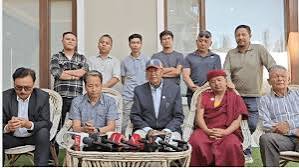
The Centre is set to hold a fresh round of talks with representatives of Ladakh on September 9 in New Delhi, in an attempt to address the region’s long-standing political and constitutional demands. The meeting assumes significance as Ladakh-based organisations continue to press for statehood, constitutional safeguards, greater democratic representation and protection of land and employment opportunities.
The talks have been convened by the Ministry of Home Affairs (MHA) and come at a politically sensitive moment. Ladakh’s Leh Apex Body (LAB) and the Kargil Democratic Alliance (KDA), which have jointly spearheaded the agitation, have indicated that they are willing to engage with the Centre but expect the dialogue to produce concrete outcomes.
The proposed meeting has also prompted Ladakh groups to temporarily defer a planned Kargil-Leh foot march that was intended to highlight the region’s demands. Leaders have said the march could be revived if the September 9 discussions fail to produce satisfactory progress.
Why the September 9 meeting matters for Ladakh 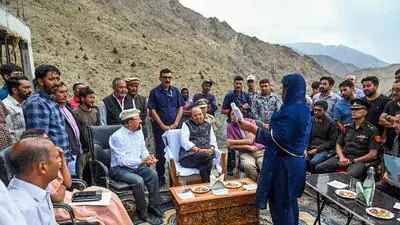
Ladakh has been witnessing a sustained political movement since the region was separated from the erstwhile state of Jammu and Kashmir and made a Union Territory in 2019.
While the creation of the Union Territory fulfilled a long-standing demand for greater administrative separation, the absence of an elected legislature at the UT level subsequently became a major concern among sections of Ladakh’s political leadership and civil society.
The LAB and KDA have therefore sought stronger constitutional and political safeguards. Their demands include statehood for Ladakh, inclusion under the Sixth Schedule of the Constitution, protection of land and jobs, greater political representation and safeguards for the region’s fragile environment.The organisations have held several rounds of discussions with the Centre since 2021, but the major political demands have remained unresolved.
Kargil Leh Foot march put on hold
The proposed Kargil-Leh foot march had been planned as a major public mobilisation around the demands for statehood and constitutional protection.
However, following the Centre’s decision to convene talks on September 9, Ladakh groups decided to postpone the march. Leaders described the decision as an opportunity for the government to demonstrate that it was serious about resolving the issues through dialogue.
The decision does not mean that the agitation has been withdrawn. Ladakh leaders have warned that protests could resume on a larger scale if the talks fail to deliver meaningful progress.
Sonam Wangchuk, one of the prominent voices associated with the movement, has said that the region could be compelled to launch a much larger agitation if the Centre does not make concrete progress on the core demands.
What Ladakh leaders want?
The political agenda being pushed by the LAB and KDA revolves around constitutional protection and greater self-governance.
One of the most prominent demands is statehood. Leaders argue that an elected legislature would provide the people of Ladakh with greater control over policies affecting the region.
Another major demand is inclusion under the Sixth Schedule, which provides special constitutional protections for tribal areas and enables autonomous governance arrangements.
Ladakh leaders also want stronger safeguards for employment and land ownership. They fear that without adequate protections, the region’s demographic, cultural and ecological character could come under pressure.The movement has also highlighted the need for greater political representation and protection of Ladakh’s fragile Himalayan environment.
Centre’s approach regarding Ladakh
The Centre has maintained dialogue with Ladakh representatives and has taken several administrative steps aimed at strengthening local governance.
In a significant recent development, the government announced that all districts in the Union Territory of Ladakh will have autonomous hill development councils. The move has been presented as an effort to increase local participation in governance and empower communities at the district level.
However, Ladakh’s political groups have maintained that administrative reforms alone cannot substitute for their core demands concerning statehood, constitutional safeguards and an elected legislature.
The September 9 meeting will therefore be closely watched for whether the government places concrete proposals on the table.
Shadow of last year’s violence
The talks also come against the backdrop of the violence that erupted in Ladakh in September 2025 during protests over statehood and constitutional safeguards.
The LAB has demanded withdrawal of cases registered after the violence, compensation for victims and publication of the inquiry commission’s report. These issues are also part of the wider agenda being pursued by the organisation.
The anniversary of last year’s violence had been expected to trigger fresh demonstrations. However, the LAB postponed its planned protest programmes ahead of the September 9 talks, while warning that the agitation could intensify if the dialogue fails.
Read more like this:
- PM Modi Inaugurates 150 Km Key Stretch of Vadodara Mumbai Expressway
- PLI Scheme क्या है? शामिल होने से पहले अपनी कंपनी और सेक्टर की पात्रता कैसे जांचें?
- Term Insurance vs Life Insurance: अपनी जरूरत और उम्र के हिसाब से सही पॉलिसी कैसे चुनें?
A crucial test for dialogue
The September 9 meeting could become an important test of the Centre’s engagement with Ladakh’s political leadership. For the government, the challenge will be to balance local demands with strategic, administrative and constitutional considerations in a sensitive border region.
For Ladakh’s representatives, the key question will be whether the talks move beyond assurances and produce a clear roadmap on political representation, constitutional safeguards and governance.
If the meeting produces tangible progress, it could create space for a negotiated settlement and reduce tensions. If it fails to satisfy the leadership of Leh and Kargil, the deferred foot march and other forms of protest could return.
Conclusion
The Centre’s decision to invite Ladakh leaders for talks on September 9 has temporarily opened a new window for political dialogue. The postponement of the proposed Kargil-Leh foot march indicates that the region’s leadership is prepared to give negotiations another chance.
However, Ladakh’s leaders have made it clear that they expect concrete and result-oriented discussions, particularly on statehood, Sixth Schedule protections, democratic representation, land and employment safeguards, and issues arising from last year’s violence.
The outcome of the September 9 meeting could therefore determine whether Ladakh’s prolonged agitation moves towards a negotiated political solution or enters another phase of mass mobilisation.