Join
Join
 Shorts

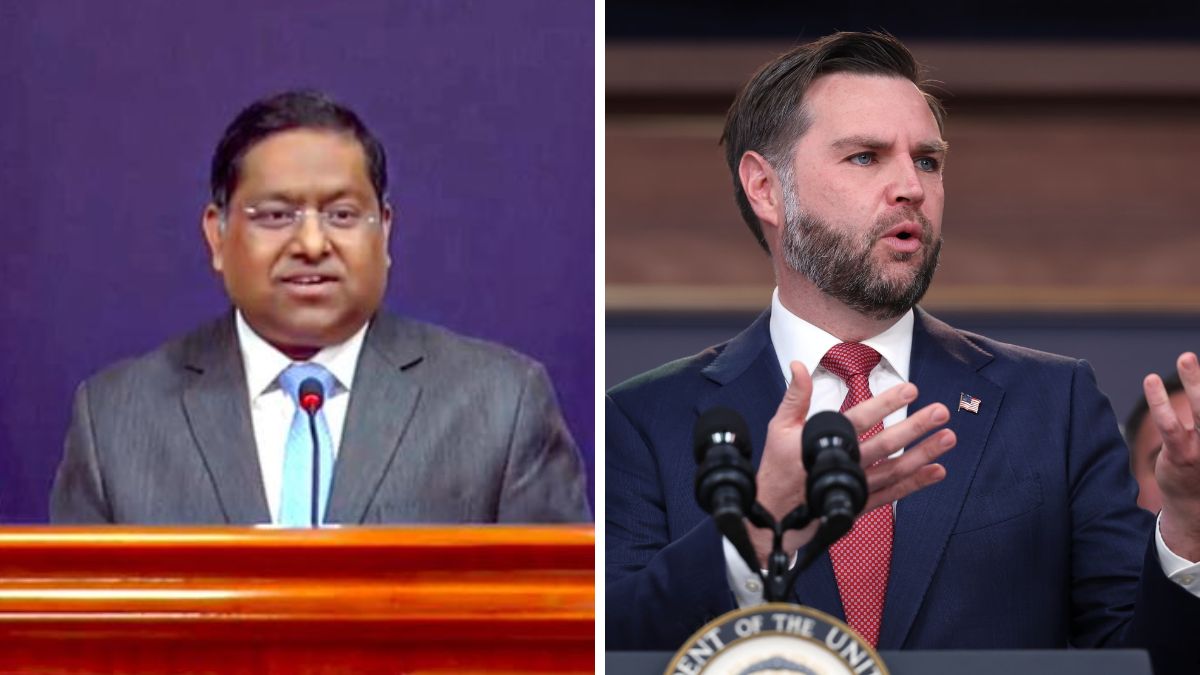
India has strongly criticised the United States over its decision to suspend several major technology companies from a programme linked to employment-based Green Cards. The Indian government has also described US Vice President JD Vance’s remarks about foreign workers as “deeply offensive,” defending the contribution of Indian professionals to the American economy.
The controversy erupted after the administration of US President Donald Trump suspended Permanent Labour Certification (PERM) applications for eight major technology companies amid allegations of misuse of foreign-worker programmes. The affected companies include Microsoft, Adobe, Tata Consultancy Services (TCS), Infosys, Wipro, HCLTech, Cognizant and Capgemini.
The decision has raised concerns among Indian technology professionals working in the United States, particularly those hoping to obtain permanent residency through employer sponsorship.
India Objects to JD Vance’s Remarks
India’s Ministry of External Affairs (MEA) strongly objected to Vance’s description of foreign professionals working on H-1B visas as “foreign indentured servants.”
The ministry said such terminology was unwarranted and ignored the valuable contribution Indian professionals make to the US economy and its innovation ecosystem.
India also highlighted the painful historical and colonial associations of the expression, stating that using such language to describe skilled foreign workers was deeply offensive.
The government’s response reflects its concern over how Indian professionals are being portrayed amid growing political debates in the United States about immigration, employment and the protection of domestic workers.
Indian technology professionals have played an important role in the growth of America’s technology industry, contributing to software development, scientific research, engineering, artificial intelligence and other advanced fields.
Why Has the US Suspended PERM Applications?
The US administration has argued that restrictions are necessary to address alleged abuses of immigration programmes and protect employment opportunities for American workers.
US officials have accused certain companies of relying on foreign workers in ways that could disadvantage domestic employees. Vance has also raised concerns about companies allegedly replacing American workers with foreign professionals.
However, the affected companies and their supporters have challenged aspects of this narrative. Microsoft, for instance, has said that a large proportion of its H-1B applications were intended for existing employees rather than new hires.
The suspension of PERM applications is significant because the programme is an important step in the process through which employers sponsor eligible foreign workers for employment-based permanent residency, commonly known as a Green Card.
Nevertheless, the PERM programme is separate from the H-1B visa system, which allows US employers to employ eligible foreign professionals in specialised occupations.
What Does the Decision Mean for Indian Workers?
The Indian government has clarified that the suspension of PERM applications does not automatically invalidate existing H-1B visas or change the legal status of current visa holders and their dependents.
However, eligible employees of the affected companies could face delays or complications in their Green Card applications. The exact consequences will depend on individual circumstances and the scope and duration of the restrictions.
For many Indian professionals, permanent residency is an important long-term goal. It can provide greater stability, employment flexibility and opportunities to settle in the United States.
Any interruption in the sponsorship process could therefore create uncertainty for workers and their families, especially those who have already spent several years navigating the immigration system.
The development could also affect companies seeking to retain experienced employees in highly competitive technology sectors.
India Highlights the Mutual Benefits of Skilled Migration
India has emphasised that the movement of skilled professionals benefits both countries and should not be viewed simply as a competition between foreign and domestic workers.
According to the MEA, international talent mobility supports innovation, research, productivity, competitiveness and job creation in the United States. Indian professionals contribute their expertise while also supporting businesses, technological development and economic growth.
The Indian government has maintained that restrictions on professional mobility do not advance the shared ambitions of the two countries.
India and the United States have extensive economic and strategic ties, with cooperation spanning technology, trade, education, defence and scientific research. Their technology industries are closely connected, making immigration policy an important issue in bilateral relations.
Implications for India-US Relations
The dispute comes at a time when both countries have reasons to strengthen economic and technological cooperation. However, disagreements over immigration and skilled-worker mobility could create additional pressure on an already complex relationship.
For Indian IT companies, the immediate challenge will be to understand the implications of the restrictions, support affected employees and assess whether alternative staffing or immigration arrangements are available.
For policymakers, the challenge is to balance legitimate concerns about labour-market fairness with the economic advantages of attracting global talent.
The controversy also highlights the importance of respectful public discourse. While governments can debate immigration rules and investigate alleged violations, broad descriptions of foreign professionals risk overlooking the individual contributions of millions of skilled workers.
Read more like this:
- Delhi CJP Protest Live: नेहा बोरा के साथ प्रदर्शनकारियों का जंतर-मंतर की ओर मार्च, 1500 से ज्यादा लोग हिरासत में- दीपके की जगह अजिंक्य शिंदे करेंगे आंदोलन का नेतृत्व
- सीजेपी प्रदर्शन: दिल्ली-NCR में जाम से वाहनों की लंबी कतारें, हजारों लोग फंसे; इन रास्तों पर जाने से बचें
Conclusion
India’s strong reaction to the US decision and JD Vance’s remarks underscores the importance New Delhi places on protecting the dignity and interests of its citizens working abroad.
Although the PERM suspension does not automatically affect existing H-1B visas, it could complicate permanent-residency plans for eligible employees of the affected companies.
As the situation develops, Indian professionals and technology firms will closely monitor further announcements from Washington. The broader question remains whether India and the United States can address immigration-related concerns while preserving the mutual benefits of skilled talent, innovation and economic cooperation.
The outcome will matter not only to Indian IT companies and their employees but also to the future of technology partnerships between the two countries.