Join
Join
 Shorts


Prime Minister Modi on Friday congratulated Indian Space Research Organisation (ISRO) after the successful launch of the GSLV-F17 rocket carrying EOS-05, describing the achievement as an “outstanding” milestone for India’s space programme. The successful mission has added another significant chapter to the country’s growing capabilities in Earth observation and space-based imaging.
The mission is particularly important because EOS-05 is India’s first imaging satellite designed to operate from a geosynchronous orbit. Unlike conventional Earth observation satellites that repeatedly pass over different parts of the planet, a geosynchronous imaging satellite can maintain a near-continuous view of a particular region. This capability has important applications in areas ranging from weather monitoring and disaster management to agriculture, infrastructure planning and strategic surveillance.
PM Modi praises ISRO scientists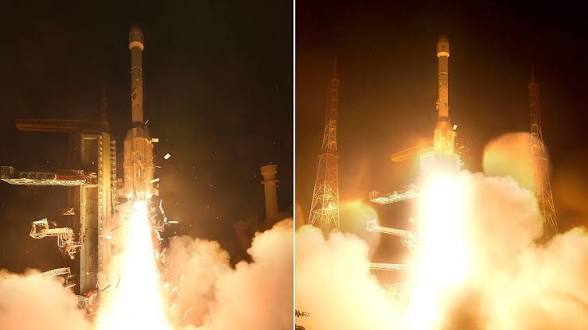
Following the successful launch, Prime Minister Narendra Modi expressed his appreciation for ISRO and its scientists. Calling the mission an “outstanding achievement,” the Prime Minister said the success was a matter of pride for the nation.
The Prime Minister’s message comes against the backdrop of a series of important achievements by India’s space sector. In recent years, ISRO has expanded its capabilities across launch vehicles, Earth observation, navigation, communications and deep-space exploration. The government has also placed increasing emphasis on strengthening India’s wider space ecosystem and encouraging private-sector participation.
ISRO’s official information confirms that the GSLV-F17/EOS-05 mission successfully accomplished its objective, with the satellite placed into its intended orbit. The GSLV-F17 is the 19th flight of India’s Geosynchronous Satellite Launch Vehicle.
A new capability for Earth observation
The biggest technological significance of EOS-05 lies in its imaging capability from geosynchronous orbit. ISRO describes it as a state-of-the-art Earth observation spacecraft and India’s first-ever imaging satellite from geosynchronous orbit.
A satellite positioned in this type of orbit can repeatedly observe the same broad region of Earth. Such continuous observation can be extremely valuable when events are developing rapidly and frequent updates are required.
For example, information generated by the satellite could potentially support monitoring of severe weather systems, floods, forest fires and other large-scale natural events. It can also contribute to agriculture and forestry applications by providing data over areas of interest at regular intervals.
The ability to obtain frequent imagery is particularly useful when compared with observation systems that depend on a satellite returning over the same location after a longer interval.
Strategic importance for national security
The EOS-05 mission also has a strategic dimension. Ahead of the launch, reports highlighted its potential to provide a continuous watch over strategically important areas, including India’s borders with China and Pakistan. The satellite has therefore been described as an important addition to India’s space-based surveillance architecture.
Space-based observation has become an increasingly important component of modern national security. Satellites can provide information over difficult terrain and allow authorities to monitor changes across large areas without relying exclusively on ground-based systems.
For India, which has extensive and geographically challenging borders, such capabilities can complement existing surveillance systems. Continuous or frequent satellite imagery can help identify changes in terrain, infrastructure and activity in sensitive regions
GSLV-F17 adds another successful flight to ISRO
The launch vehicle used for the mission was GSLV-F17, part of India’s Geosynchronous Satellite Launch Vehicle programme. According to ISRO, the vehicle successfully placed EOS-05 into a sub-geosynchronous transfer orbit as part of the mission profile.
The mission represents another demonstration of India’s ability to use its indigenous launch infrastructure for increasingly sophisticated spacecraft.
The GSLV programme has played an important role in developing India’s capacity to launch heavier satellites into higher-energy orbits. Earlier GSLV missions have carried communication, navigation and meteorological spacecraft.
ISRO’s official list records GSLV-F17 as the 19th GSLV flight. The mission follows other important launches, including the GSLV-F16 mission that carried the NISAR satellite in July 2025.
Why geosynchronous imaging matters
Traditional Earth observation satellites often operate in low Earth or sun-synchronous orbits. They travel around the planet and provide detailed images of different areas during successive passes.
A geosynchronous imaging satellite serves a different purpose. By remaining associated with the same region as Earth rotates, it can provide much more frequent observation of that area.This can be particularly useful for monitoring rapidly changing phenomena.
Weather systems are one obvious example. Continuous observation can help scientists and agencies track cloud formations and other atmospheric developments. Similar capabilities can be useful for monitoring large-scale environmental changes and natural disasters.
Strengthening India’s space programme
The successful EOS-05 mission comes at a time when India is seeking to expand its role in the global space sector.
ISRO’s achievements during the 2025-26 financial year included challenging missions, technology demonstrations and efforts to expand awareness and skills in space technology. The space agency has also been supporting the development of a broader private-sector space ecosystem.
The government has increasingly encouraged private companies and startups to participate in space activities. This approach is aimed at complementing ISRO’s work while creating new capabilities in satellite manufacturing, launch services, Earth observation and space applications.
The EOS-05 success therefore has significance beyond a single satellite launch. It demonstrates how India’s space programme is developing specialized capabilities while continuing to strengthen its launch infrastructure.
A boost after earlier challenges
The mission also represents an important technological step following previous challenges involving India’s Earth observation programme.
In August 2021, the GSLV-F10/EOS-03 mission was unsuccessful. Since then, ISRO has continued to refine its launch systems and mission capabilities. The successful EOS-05 mission demonstrates the agency’s ability to learn from earlier setbacks and return with more advanced missions.
The space programme’s progress has increasingly been characterized by a combination of reliability, technological ambition and diversification.
Applications in disaster management and development
One of the most important benefits of Earth observation satellites is their ability to provide information during emergencies.
During floods, landslides, cyclones or forest fires, satellite imagery can help authorities assess the extent of damage and identify affected areas. Frequent observations can also help track the progression of an event.
For agriculture, satellite data can contribute to crop monitoring, land-use assessment and water-resource management. Forestry agencies can use imagery to monitor vegetation and changes in forest areas.
Read more like this:
- मातृत्व अवकाश के कारण पद या करियर की संभावनाएं नहीं छीनी जा सकतीं: दिल्ली हाईकोर्ट
- दिल्ली में बढ़ रहा डेंगू का खतरा, 311 मामले सामने आने से चिंता बढ़ी; मच्छर के काटने के कितने दिन बाद दिखते हैं लक्षण?
- ग्रामीण भारत के लिए डिजिटल साक्षरता के रास्ते खोलती PMGDISHA योजना, जानें इसके बारे में सबकुछ!
India’s growing space ambitions
The successful launch is another indication of India’s expanding ambitions in space. From navigation satellites and communication spacecraft to Earth observation and planetary exploration, the country’s space programme has become increasingly diverse.
The success of missions such as EOS-05 also supports India’s broader objective of developing space-based capabilities that serve both strategic requirements and everyday developmental needs.
Prime Minister Modi’s praise reflects the national importance attached to these achievements. The mission combines indigenous launch technology, advanced satellite design and practical applications of space-based data.
Conclusion
The successful launch of EOS-05 aboard GSLV-F17 is a significant achievement for India’s space programme. ISRO has demonstrated its ability to deploy an advanced Earth observation satellite from geosynchronous orbit, opening new possibilities for continuous monitoring of specific regions.
Prime Minister Narendra Modi’s description of the mission as an “outstanding achievement” highlights the significance attached to the accomplishment.
Beyond the immediate success of the launch, EOS-05 could have wide-ranging applications in disaster management, weather observation, agriculture, environmental monitoring and strategic surveillance. Its ability to provide frequent imagery from geosynchronous orbit represents an important technological advancement for India.
With the successful GSLV-F17 mission, ISRO has once again demonstrated the growing sophistication of India’s space capabilities. As the country expands both its government-led space programme and its private space ecosystem, missions such as EOS-05 are likely to play an increasingly important role in strengthening India’s technological, developmental and strategic capabilities.