Join
Join
 Shorts

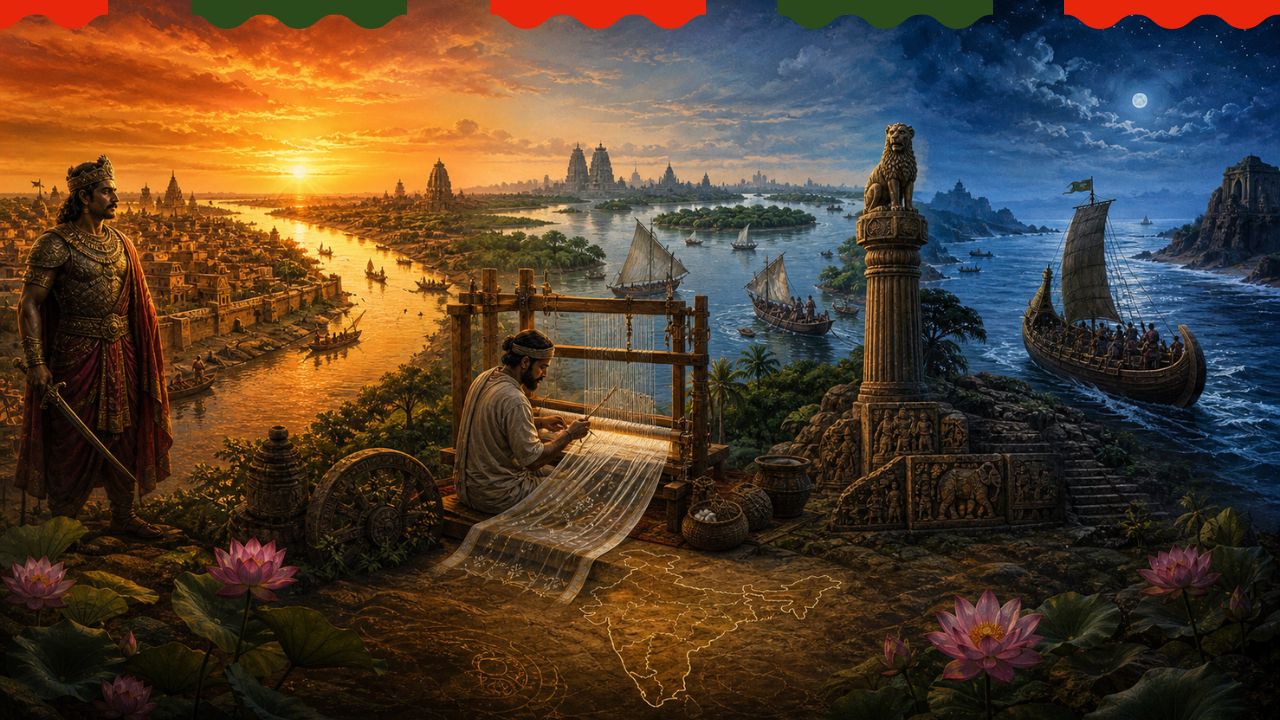
Anga, Vanga, Kalinga: Ancient Civilizations That Modi Has Made into a Modern Political Argument: In the past, long before Bihar, West Bengal, and Odisha were administrative units, they were sibling kingdoms that had shaped trade routes and morality as well as the maritime power of Asia. Today, the BJP has restored its name and its significance as a model for civilization in eastern India.
May 5, 2026
Following the BJP’s landslide victory in the West Bengal Assembly elections 2026, Prime Minister Narendra Modi invoked the phrase “Anga, Banga, Kalinga” in his address to party workers at the BJP headquarters in New Delhi. He called the three regions the historical pillars of eastern India, arguing that India’s rise is impossible without their resurgence. What was once confined to cultural and historical memory is now being actively reshaped by the BJP into a contemporary political and economic argument.
The implications stretch well beyond symbolism: a politically consolidated eastern bloc spanning Bihar, Odisha, and West Bengal would give the party a formidable saffron corridor across the entire eastern flank of India — one that could redraw both the country’s political map and its economic priorities.
One Origin, Five Brothers
The link between the three regions goes through the Mahabharata. Dirghatamas was a sage who had five sons via Queen Sudeshna, the spouse of King Bali. Each son erected the kingdom that bears his name -the five Angas – Anga, Vanga, Kalinga, Pundra, and Suhma -all of which cover the whole eastern coast of the subcontinent from to the plains in Bihar up to the deltas in river from Bengal, along with the coastal regions of Odisha.
If read in the context of history or as a myth of the foundation, the implications are striking that the regions we believe to be completely separate were once thought of as being brothers, formed with the same influences, and emerged out of the same place.
Anga: Where Merit Mattered More Than Birth
Anga, located around modern Bhagalpur in Bihar, was one of the sixteen Mahajanapadas — famous kingdoms from the sixth century BCE in India. Its capital city, Champa, was regarded alongside Varanasi and Rajgriha as among the most well-known cities in the early north. Buddhist texts from the Anguttara Nikaya mention it as one of the nations of great importance.
However, it is through the Mahabharata that Anga is most vividly portrayed. In the Mahabharata, when warrior Karna was disqualified from dueling Arjuna due to the fact that he was unable to declare a royal lineage, it was Duryodhana who made Karna King of Anga at that moment.
Karna — the unloved daughter of a princess brought up by a charioteer– was crowned Angraj. The tale of Angraj is in many ways the original argument of the ancient subcontinent to choose merit over privilege, the assertion that value should not be determined solely by birth.
Vanga / Banga: The Kingdom That Wove Air
“Banga” or “Vanga” is a reference to the southern regions of the present West Bengal and Bangladesh. This was an ancient kingdom dominated by trade, rivers, and remarkable craftsmanship. The Arthashastra, written in the 3rd century BCE, describes the extraordinary weavings from Vanga — the ancestors of the muslins that would later be enthralled by Mughal emperors as well as European merchants. Weavers were employed in the hot, humid mornings before dawn, making thread counts that could reach five hundred, something that’s far beyond the capabilities of modern technology. The fabric was dubbed “woven air” and “skin of the moon.”
This tradition was systematically destroyed during the British colonies. Weavers suffered from poverty while supply chains changed to the mills of Manchester. The devastation of Bengal muslin is one of the most enduring tragic events of the empire. Today, the descendants of those weavers who lived in Nadia district and further across the border in Bangladesh still practice the technique of Jamdani weaving, which is recognized by UNESCO as an irreplaceable human cultural heritage.
Kalinga: The War That Changed a Continent
Kalinga, which covers present-day Odisha along with parts of north Andhra Pradesh, carries perhaps the most significant historical weight of the three. In 261 BCE, Emperor Ashoka, a member of the Maurya dynasty, attacked Kalinga as part of one of the bloodiest battles of the world’s history. About 100,000 people died, and a further 175 000 were exiled.
The destruction was so extensive that Ashoka abandoned all military intervention, accepted Buddhism, and issued the rock edicts that reshaped governance throughout the subcontinent. The Dhauli hills, close to Bhubaneswar, which is where those decrees are still carved into stone, are one of the most peaceful ancient places in India.
Kalinga, however, did not remain defeated. The kingdom was revived under Kharavela of the Mahameghavahana dynasty. It revamped its navy, sending merchant mariners referred to as Sadhabas over to the Bay of Bengal in large wooden vessels known as Boitas. They crossed the Bay of Bengal to Java, Sumatra, and Bali, trading in spices, ivory, diamonds, and textiles.
Their influence was so profound that both the Ramayana and the Mahabharata were incorporated to become the Balinese shadow-puppet theater. Every year in November, Cuttack is the host of Bali Jatra, which is one of Asia’s biggest open trade fairs to mark the voyages. Within Bali, the city itself, Hindu groups still practice an ancient ritual of floating on small boats to symbolize taking their young ones back to their homeland of Kalinga.
Read Also: Tamil Nadu Election Results 2026: “VIJAY” fever raises the temperature,Shakes DMK vs AIADMK Battle
The Political Implication
They were not aristocratic kingdoms. They were civilisational experimentations that established trade routes, morality and artistic practices across the entire region. The eastern region of India is often dismissed as a marginal part of national narratives, once the heart of the globe it knew.
What was previously only a matter of historical and cultural memories is currently being transformed by the BJP into a modern economic and political argument. An economically consolidated eastern bloc, which includes Bihar, Odisha, and West Bengal, will give the BJP an enormous saffron corridor through the entire eastern rim of India. Old names are more powerful than a single news story will ever be able to be able to.