Join
Join
 Shorts

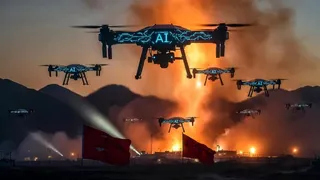
Artificial Intelligence AI is emerging as a major component of India’s defence modernisation, with an advanced AI-enabled manned-unmanned teaming system being developed in Dehradun. The project aims to combine the capabilities of manned combat platforms, such as tanks, with unmanned aerial systems that can conduct surveillance and analyse battlefield information.
The initiative is being pursued by India Optel Limited in collaboration with the Ordnance Factory in Chandigarh and IIT Ropar. The project reflects a wider effort by India’s defence establishment to integrate artificial intelligence, drones, sensors and data analytics into military operations.
Drone to operate alongside tanks
One of the key concepts under development involves a small unmanned aerial vehicle working alongside a tank.
Under the proposed system, the drone could fly ahead of the tank during both day and night operations, monitoring the terrain and identifying objects or activities that may be relevant to the crew.
The concept is based on manned-unmanned teaming, where human-operated military platforms work in coordination with autonomous or semi-autonomous machines.
Instead of sending soldiers or a tank crew directly into an uncertain area to gather information, an unmanned platform could provide additional information from a safer distance.
The system is still being developed, and its eventual operational capabilities will depend on testing, validation and integration with existing military platforms.
AI will analyse battlefield information
Traditional surveillance drones generally transmit photographs or video to an operator, who then studies the information and decides what may be important.
The proposed AI-enabled system seeks to add another layer to this process. Data collected by sensors on the drone could be processed using artificial intelligence to help identify vehicles, objects or other activities of potential military significance.
This could allow soldiers to receive processed information rather than having to examine every image manually.
The broader objective is to reduce the time between detecting an object and understanding its significance. Faster access to battlefield information can be particularly important in situations where conditions change rapidly.
India’s Defence Research and Development Organisation is already working on several AI and machine-learning technologies involving image and video analytics, object detection, autonomous navigation and target identification.
Research into AI-enabled weapon sights
The Dehradun-based research effort also includes work on an AI-enabled weapon sight system.
The objective is to combine conventional optical equipment with AI-assisted identification and tracking capabilities. Such systems are being explored for situations in which targets may be difficult to identify because of camouflage, darkness or challenging environmental conditions.
AI-based image processing can potentially help military personnel analyse visual information more quickly. However, such technology is intended to assist operators rather than eliminate human involvement in military decision-making.
India’s defence technology programmes increasingly emphasise this combination of human judgement and machine-assisted information processing.
India’s larger defence AI push
The Dehradun project is part of a much broader transformation underway across India’s armed forces.
The DRDO lists a range of AI-related projects, including AI-based image and video analytics, satellite-sensor data processing, autonomous navigation, combat-environment event detection, autonomous target identification and AI-enabled command-and-control applications.
The Ministry of Defence’s innovation programmes have also invited industry and start-ups to develop technologies involving autonomous systems, smart ammunition, cognitive electronic warfare and manned-unmanned teaming.
One listed challenge involves AI-enabled autonomous robotic systems designed to work with special forces, illustrating how military planners are exploring applications beyond conventional drones.
AI as a battlefield decision-support tool
India’s armed forces are also exploring AI as a way of processing the enormous amount of information generated during military operations.
A recent assessment of India’s defence-AI efforts noted that the Army is increasingly using AI and digital engineering to organise data, develop training datasets and test equipment in virtual environments.
The concept of an AI “spine” for the armed forces has also been discussed by Defence Secretary Rajesh Kumar Singh. According to his remarks, India is working towards integrating AI across military applications rather than relying on isolated systems.
The idea is to create a connected ecosystem in which information from sensors, drones, satellites and other military platforms can contribute to a common operational picture.
Lessons from modern conflicts
Recent conflicts around the world have demonstrated the growing importance of drones, electronic warfare, artificial intelligence and real-time battlefield intelligence.
Ukraine and other conflict zones have highlighted how relatively inexpensive unmanned systems can affect traditional military operations. India is therefore examining ways to combine emerging technologies with existing platforms.
AI can potentially assist with surveillance, logistics, threat detection, image analysis and battlefield planning. The Indian military has also explored AI applications for counter-drone operations and other security requirements.
The Ministry of Defence’s iDEX programme, for example, lists an AI-powered anti-drone system that combines AI and machine learning with computer vision and electronic countermeasures.
Human control remains important
Despite rapid technological development, AI does not remove the need for trained military personnel.
Military decisions involve complex factors that cannot always be reduced to patterns identified by algorithms. AI systems can also make mistakes, particularly when data is incomplete, conditions change or an object is obscured.
For this reason, human oversight remains an important part of India’s approach to military AI. Recent discussions within the armed forces have emphasised the importance of using AI as a decision-support and information-processing capability rather than treating it as an unquestionable authority.
Dehradun’s emerging role
The development of AI-enabled military technology in Dehradun adds another dimension to the city’s role in India’s defence and technology ecosystem.
Uttarakhand has also seen growing attention to drone and counter-drone technologies. In March 2026, advanced counter-drone systems were demonstrated in Dehradun, with participation from government, police, armed forces, paramilitary organisations and academic institutions.
The combination of defence institutions, research organisations and technology companies could help accelerate the development of indigenous systems.
Read more like this:
- Mumbai Airport T1 Closure: 10 Million Passengers May Shift to Navi Mumbai, Flights and Travel Costs to Change
- राहुल गांधी ने लॉन्च की ‘सत्याग्रह’ वेबसाइट, देशभर के आंदोलनों को एक मंच पर लाने की पहल
What lies ahead?
The Dehradun project illustrates how the future battlefield could increasingly involve teams of soldiers, tanks, drones, sensors and AI systems working together.
If successfully developed and integrated, such technology could improve battlefield awareness, reduce the exposure of personnel to uncertain areas and speed up the processing of information.
However, the transition from a research prototype to a dependable military system requires extensive testing under realistic conditions. Reliability, cybersecurity, communications, sensor performance and human oversight will all be critical.
India’s growing investment in defence AI suggests that artificial intelligence is moving from an experimental technology towards an important component of military modernisation. The Dehradun-developed manned-unmanned teaming system is one example of how that transformation could eventually change the way Indian forces gather information and operate on future battlefields.