Join
Join
 Shorts

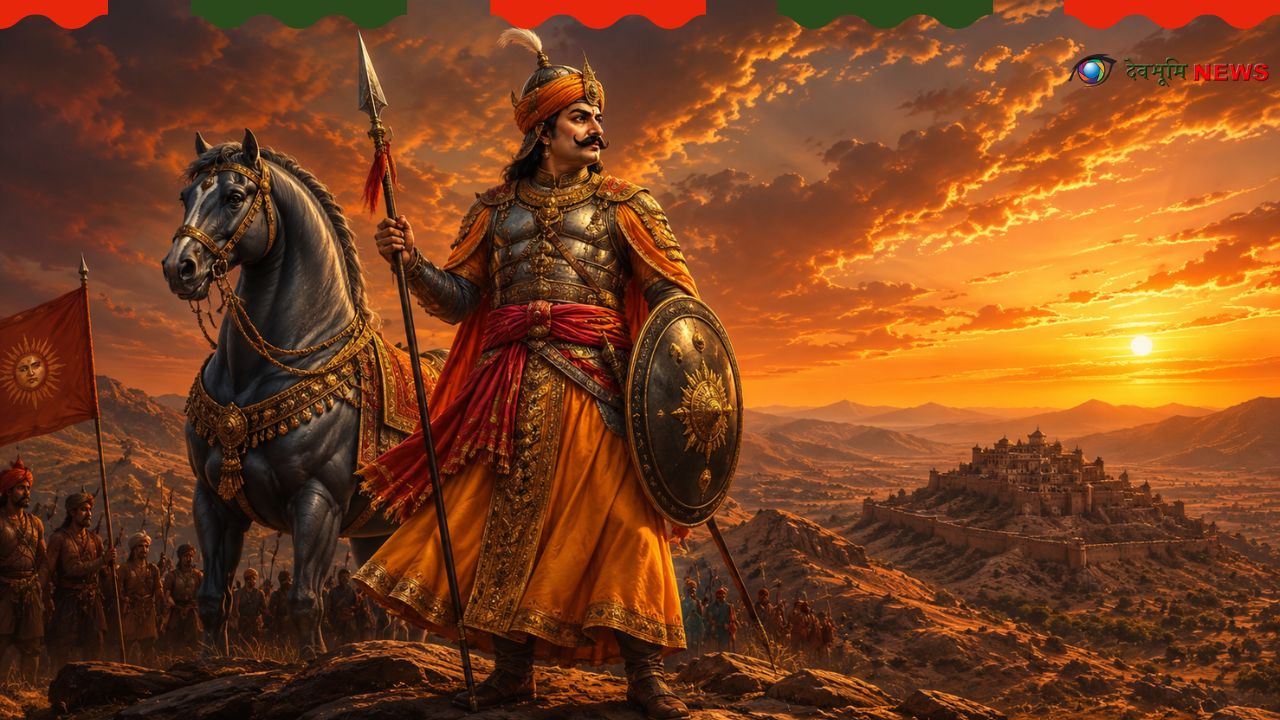
“He who never bowed before the Mughal Emperor and chose forests over the comfort of a crown—Maharana Pratap remains the greatest symbol of honor, sacrifice, and Rajput valor in Indian history.”
| Detail | Information |
|---|---|
| Full Name | Maharana Pratap Singh Sisodia |
| Born | 9 May 1540 |
| Birthplace | Kumbhalgarh Fort |
| Died | 19 January 1597 |
| Place of Death | Chavand |
| Age at Death | 56 Years |
| Dynasty | Sisodia Rajput (Suryavanshi Lineage) |
| Kingdom | Mewar |
| Father | Maharana Udai Singh II |
| Mother | Rani Jaivanta Bai |
| Successor | Amar Singh I |
| Famous Title | The Lion of Mewar |
1. Early Life and Birth
Birth and Royal Lineage
Maharana Pratap was born on the 9th of May, 1540, in the magnificent Kumbhalgarh Fort in present-day Rajasthan. He was a member of the highly regarded Sisodia Rajput family, which was a branch of the Suryavanshi family that traced their origins back to Lord Rama.
He was the son of Maharana Udai Singh II, who was the ruler of Mewar and the founder of Udaipur. Udaipur. Her mother, Rani Jaivanta Bai, was renowned for her bravery and wisdom as well as her strong moral values.
Childhood and Training
At an early age, Pratap received his training in accordance with strict Rajput warrior tradition. His training included:
- Horsemanship
- Fighting with swords
- Archery
- Spear combat
- Military strategy
- Survival in difficult terrain
He became a fearless fighter with incredible fitness and strength.
The Bhil tribes of Mewar loved to call him “Kika,” due to the close friendship he formed with the tribal community throughout his life.
2. Ascension to the Throne of Mewar
Becoming the 54th Ruler of Mewar
After the demise of Maharana Udai Singh II in 1572, a succession dispute was triggered due to Udai Singh’s preference for his son Jagmal as his heir.
But the upper nobles and the warriors of Mewar believed that Pratap was a good warrior with the necessary qualities to protect the kingdom in turbulent times. This led to Maharana Pratap being named as the 55th ruler in Mewar by Gogunda.
A Kingdom Under Threat
When Pratap was elected as the new ruler, Mewar faced severe political and military pressure
- A large portion of Rajputana was already accepting Mughal rule.
- Emperor Akbar was expanding rapidly the Mughal Empire.
- The most important parts of Mewar were constantly under danger.
Despite all the challenges, Pratap refused to surrender the sovereignty of Mewar.
3. Defiance Against the Mughal Empire
Akbar’s Diplomatic Missions
Emperor Akbar sent various diplomatic missions to ask Maharana Pratap to recognize Mughal Supremacy.
The mission was led by:
- Jalal Khan Qurchi
- Man Singh I
- Bhagwant Das
- Todar Mal
Each mission provided peace along with political alliances as well as royal priviliges.
Refusal to Submit
Maharana Pratap strongly opposed every suggestion. For Pratap, freedom and Rajput honor were more significant than wealth or political security.
In a time when numerous Rajput rulers were acquiescing to Mughal power, Pratap stood almost completely on his own in the fight against his country’s Mughal Empire.
His courage made him an iconic image of strength and courage.
4. The Battle of Haldighati (18 June 1576)
Beginning of the Historic Battle
The war eventually resulted in the infamous Battle of Haldighati, fought on 18 June 1576, close to Haldighati, located in Rajasthan.
The Mughal army, led by Man Singh I, greatly outnumbered the troops of Mewar.
Estimated Strength
| Army | Estimated Strength |
|---|---|
| Mughal Forces | 80,000-100,000 |
| Mewar Forces | Around 20,000 |
Warriors of Mewar
Maharana Pratap’s army comprised the following:
- Rajput warriors from the cavalry
- Bhil tribal archers, led by Rao Poonja
- Afghan allies under Hakim Sur
Pratap personally took part in the battle on the frontline with his legendary horse Chetak.
Outcome of the Battle
While the war was not militarily decisive, it was an emotional triumph for Maharana Pratap due to:
- He was not willing to give up.
- He was able to escape safely despite his overwhelming power.
- Mughal forces were unable to capture the king.
The war became one of the biggest symbols of struggle in the history of India.
5. The Legend of Chetak
Maharana Pratap’s Loyal Horse
Chetak is considered to be an extremely famous horses in Indian history.
In the Battle of Haldighati, Chetak was severely injured when an elephant struck Chetak.
Despite his injuries, Chetak took Maharana Pratap over a rogue stream to the safety of.
Supreme Sacrifice
After the rescue of his master, Chetak collapsed and died due to his wounds.
This act of devotion became immortalized in Rajasthani poetry and folklore.
A memorial to Chetak is located in Haldighati to symbolize courage, dedication, loyalty, and sacrifice.
6. Years of Exile and Hardship
Life in Forests and Mountains
After Haldighati, Maharana Pratap was adamant against any compromise offer from the Mughals.
Instead, he opted to fight on, despite living in
- Forests
- Mountain caves
- Settlements of tribal people within the Aravalli Hills
The royal family was faced with extreme hardships and poverty throughout the period.
Struggles of the Royal Family
The ancient traditions tell us how families could survive on bread made of grass seeds because they were deficient of food.
Despite enduring a lot, Maharana Pratap never surrendered.
His perseverance became an inspiration to generations of people.
7. Bhamashah’s Historic Contribution
A Loyal Patriot of Mewar
In the darkest period of Mewar’s struggle, Pratap received the support of his faithful minister:
Bhamashah
Bhamashah gave his entire fortune, his entire wealth, to Maharana Pratap.
Rebuilding the Army
According to accounts from the past, the sum was enough to provide support for the army of 25,000 soldiers for a number of years.
Utilizing these sources, Maharana Pratap rebuilt his military power and resumed battles to reclaim lost territory.
Bhamashah’s contribution is one of the best examples of loyalty and patriotism in Indian history.
8. Reconquest of Mewar (1582-1597)
Victory at Dewair
Maharana Pratap initiated a massive attack to Mughal positions and won an important victory:
Battle of Dewair
This battle was the beginning of the revival of Mewar’s power.
Recovery of Territories
In the years following, Maharana Pratap recovered most areas of Mewar except for:
- Chittor
- Mandalgarh
- Ajmer
In 1585, Mughal tensions had weakened, as Akbar switched his attention to the northwestern campaign.
Capital at Chavand
Pratap set up an entirely new capital in:
Chavand
Then he reconstructed the administration, promoted art and culture, and consolidated the military structure of Mewar.
9. Personal Character and Ideals
A Life of Sacrifice
Maharana Pratap was said to have taken vows:
- Never ever be a queen in bed
- Do not eat anything from golden plates
- Never lived in peace until Chittor was released
This was a reflection of his extraordinary devotion to his home country.
Respect for All Communities
He maintained strong bonds with:
- Rajputs
- Bhils
- Farmers
- Artisans
- Warriors from different religions
His administration was known for the fairness and respect he showed to all of his subjects.
Physical Strength and Personality
Historical descriptions portray him as:
- Extremely powerful and tall
- Unflinching in combat
- Honest and disciplined
- We are deeply committed to honor and freedom
He had 17 wives and 11 sons, and Amar Singh I became his successor.
10. Death and Succession
Final Days
Maharana Pratap passed away in 1597. The 19th of January, 1597, in Chavand.
The legends of the past say that his internal injuries were a result of an incident while hunting with the bowstring.
He was 56 years old.
Legacy Continued
Following the death of his father, the son:
Amar Singh I
persistent resistance against the continued resistance against the Mughal Empire for several more years.
Even the Emperor Akbar is thought to have admired Maharana Pratap’s strength and determination.
11. Memorials and Legacy
Famous Memorials
The most important memorials devoted to Maharana Pratap are:
- Moti Magri—the famous sculpture of Maharana Pratap’s Chetak
- Haldighati Memorial
- Chetak Samadhi
These sites are visited by millions of visitors each year.
Maharana Pratap Jayanti
Maharana Pratap Jayanti
Every year, the festival is celebrated across Rajasthan and across many other parts of India through procession parades, celebrations, cultural programs, and celebrations.
Influence on Indian Culture
His life’s journey has inspired:
- Songs from folk and ballads
- Poetry and literature
- TV serials and films
- Textbooks for schools
- The public monuments, as well as institutions
Maharana Pratap is one of the most admired heroes of Indian time.
12. Historical Importance
Symbol of Freedom and Resistance
Maharana Pratap is known as the following:
- The most powerful emblem of Rajput resistance
- A fighter for dignity and independence
- A ruler who favored hardship over submission
His bravery shaped the cultural identity of Rajasthan over the course of centuries.
Eternal Legacy
Alongside heroes, such as:
- Chhatrapati Shivaji Maharaj
- Rani Lakshmibai
- Guru Gobind Singh
Maharana Pratap is an everlasting symbol of bravery and sacrifice, patriotism, and respect.
Conclusion:
Maharana Pratap was more than an emperor; he became a legend.
He gave up the comforts, wealth, and peace to safeguard the rights and dignity of Mewar. His unwavering stance against one of the most powerful empires turned him into a symbol for determination that inspires millions of people to this day.
“Akbar defeated kingdoms. Maharana Pratap defeated hearts. One of them built an empire. Another created a legend.”
Read More: