Join
Join
 Shorts

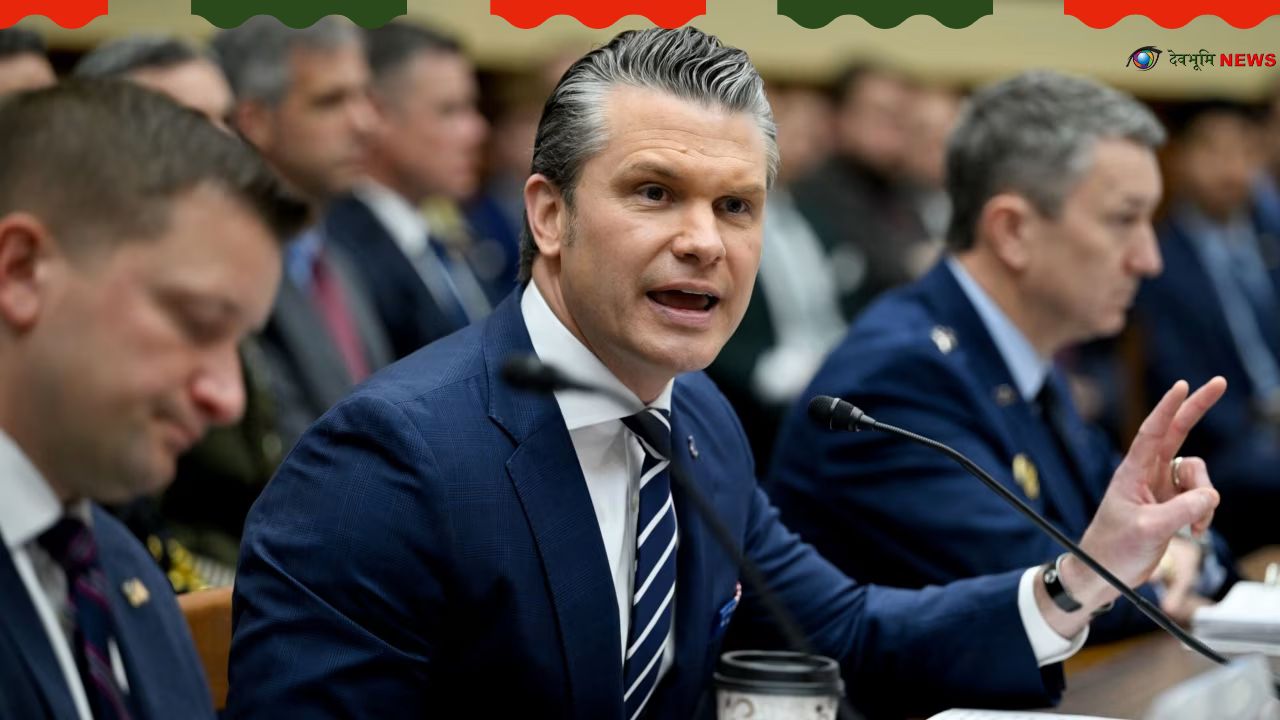
Hegseth vs. Congress: Defense Secretary Pete Hegseth faced his first Congress-level grilling since the start of the US-Iran war with the revelation of the price tag of $25 billion, as well as a fast-approaching War Powers deadline and deep partisan divisions.
What Happened at the Hearing?
US Defense Secretary Pete Hegseth testified before the House Armed Services Committee on the 29th of April, 2026—his first time under oath since the United States and Israel launched strikes against Iran on February 28th, 2026. He was joined by the chairman of the Joint Chiefs of Staff, Gen. Dan Caine, and Pentagon Comptroller Jules Hurst III.
The hearing, initially concerned with the Pentagon’s budget for the fiscal year 2027 request, quickly morphed into a nearly six-hour discussion about the need for the request, its cost, and the prospects of a war. Hegseth has been scheduled for a hearing before members of the Senate Armed Services Committee on April 30, just one day before an important deadline in the law in the War Powers Resolution.
1. The Iran War Has Cost $25 Billion—With No End in Sight
The Pentagon has publicly announced a price for the conflict. The comptroller, Jules Hurst III, told the committee that the war has thus far cost a total of 25 billion dollars (approximately PS18.5 billion), with the major portion of the money going to ammunition and the cost of expanding military assets in the Middle East.
Hurst stated that a complete accounting will be made available at a later date. In addition, the Pentagon has stated that it plans to seek $200 billion of additional financing for the campaign, in addition to the record $1.5 trillion budget proposal for defense in FY2027, the largest budget ever in Pentagon history.
When asked on the subject by Rep. Seth Moulton about the costs of war for the average American, Moulton put the amount at $600 for the average taxpayer. “I’m just wondering if they have an extra six hundred bucks lying around,” Moulton stated. Hegseth turned away and asked, “What is the cost of Iran having a nuclear weapon that they wield over us?”
Key fact: The $1.5 trillion budget proposal would be the biggest increase on US defense spending in the United States since World War II, according to the White House.
2. Hegseth Called Congressional Critics America’s “Biggest Adversary.”
In a surprisingly combative opening speech for an official of the Cabinet representative, Hegseth set a hostile tone from the start. “The biggest challenge, the biggest adversary we face at this point are the reckless, feckless and defeatist words of congressional Democrats and some Republicans,” He said.
Defense Secretary James Mattis repeatedly denied Democratic critics of distributing propaganda to our enemies and let the “hatred for President Trump” affect their judgment.
One of the most heated exchanges, California Rep. John Garamendi, directly accused Hegseth: “You have been lying to the American public about this war from day one, and so has the president.” Garamendi described the conflict as one of “geopolitical calamity” and a “strategic blunder” and declared that Trump is “stuck in a quagmire.”
Hegseth responded: “Who are you cheering for?” He also told a legislator, “Shame on you,” in a very tense moment.
Democrats have described the conflict as an unconstitutional “war of choice” that was fought without congressional approval, and a number of them used the 1973 War Powers Resolution.
Read Also: US to Strike Iran Again: “Short and Powerful” Wave of Strikes Signals Escalation in US-Iran Conflict
3. The War Powers Deadline Is Looming—and Republicans Are Divided
A moment of significance for the law is quickly coming. Friday, May 1, 2026, will mark 60 days since the day that President Trump officially informed Congress about his decision to launch the Iran strikes. According to the War Powers Resolution of 1973, President Trump is obliged to start removing troops or obtain explicit congressional approval within 60 days.
The Trump administration began strikes against Iran on the 28th of February, without prior approval from Congress. Secretary of State Marco Rubio called select members just moments before the strike began; Trump formally notified Congress two days later, on the 2nd of March.
Although House as well as Senate Democrats are repeatedly unable to get resolutions to authorize war, requiring Trump to end the war, cracks are appearing on the Republican side:
- Sen. Rand Paul (R-KY) has been vocally opposed to the legal basis for war.
- Sen. John Curtis (R-UT) wrote in a public statement that he is not in favor of extending the war past the 60-day time frame without a vote in Congress.
- Rep. Don Bacon (R-NE) told Hegseth during the meeting, “You have the constitutional right to do these things, but it doesn’t make it right or wise,” in reference to Pentagon firings. He also said “bipartisan concern” about them.
- Rep. Austin Scott (R-GA) also criticized the dismissal of Army Chief of Staff Gen. Randy George.
Republicans have a majority in both chambers and have said they are not going to force an authorization vote in the formal sense, which would leave the war on an uncertain legal basis.
4. Hegseth’s Shifting Justifications on Iran’s Nuclear Program Draw Fire
One of the most incisive lines of inquiry was directly from Rep. Adam Smith (D-WA) the top committee Democrat, who challenged Hegseth about contradictory assertions regarding Iran’s nuclear capability.
Smith explained that Hegseth earlier stated that Iran’s nuclear program would be “obliterated” following the US-Israeli war of 2025, but the administration used its nuclear programs in the context of an “imminent threat” to justify the current war just a year after.
“We had to start this war, you just said 60 days ago, because the nuclear weapon was an imminent threat. Now you’re saying it was completely obliterated,” Smith stated. “Iran’s nuclear program is exactly what it was before this war started.”
Hegseth said Iran “had not given up their nuclear ambitions” and continued to maintain thousands of missiles. Hegseth, however, refused to resolve with the obvious contradiction. Smith concluded that the conflict “left us at exactly the same place we were before.”
Read Also: Several Arrested at Ahmadi Religion of Peace and Light HQ — Cheshire Police Statement in Full
5. Military Firings and the School Strike Add to Accountability Questions
Beyond the war’s costs and strategy, lawmakers required accountability on two other fronts:
From Pentagon firings, Hegseth has reprimanded or stopped promotions of more than a dozen top Army officers without a public explanation. The hearing witnessed the first time Republican opposition—the reps. Bacon and Scott both expressed their displeasure at the dismissal of Army Chief of Staff Gen. Randy George.
Four colonels were also denied promotion to a one-star general. Two are Black, and two are female. None of them were facing discipline issues. “I anticipate other officers will be removed also,” Hegseth stated, without providing any reason.
Minab School Strike Lawmakers also pressured Hegseth regarding the US strike on the primary school located situated in Minab, Iran, during the initial days of the war. Iranian officials have claimed that the strike caused the deaths of more than 168 people, which included around 110 students. US military investigators have reportedly concluded that American forces could be to be the culprit behind the incident, unintentionally; however, a definitive ruling has not yet been made.
Rep. Ro Khanna asked Hegseth to explain the cost of the strike. The defense secretary stated that the incident “remains under investigation” and declined to give an amount in dollars. Rep. Adam Smith called the silence of the administration as an act of moral incompetence: “We made a mistake, and that happens in war… two months after it happened we refused to say anything about it, giving the world the impression that we just don’t care.”
What Comes Next?
- Thursday, 30 April, Hegseth, Gen. Caine, along with Jules Hurst, will testify before the Senate Armed Services Committee.
- Friday May 1: The 60-day War Powers deadline expires. Congress must act, or the conflict continues on legal ambiguous basis.
- Peace negotiations: Pakistan is expected to be notified of Iran’s revised peace agreement on Friday. Trump has been warning Iran to “get smart soon” as the US naval blockade on the Strait of Hormuz continues, with Brent crude soaring over the $126 mark per barrel on April 30.
- Gas prices: US average gas prices reached $4.23 each gallon on Wednesday, the most expensive since July 2022 due to the war’s economic ripples impacting American consumers.
Bottom Line
The hearing revealed a growing distance between President Obama’s positive view of the Iran conflict and the concerns expressed by lawmakers from both sides. With the War Powers deadline looming, with a price tag of $25 billion already in the books and peace talks in limbo and unable to move forward, the next few days will be crucial in determining the legal status of the war as well as its long-term political viability in the United States.