Join
 Shorts

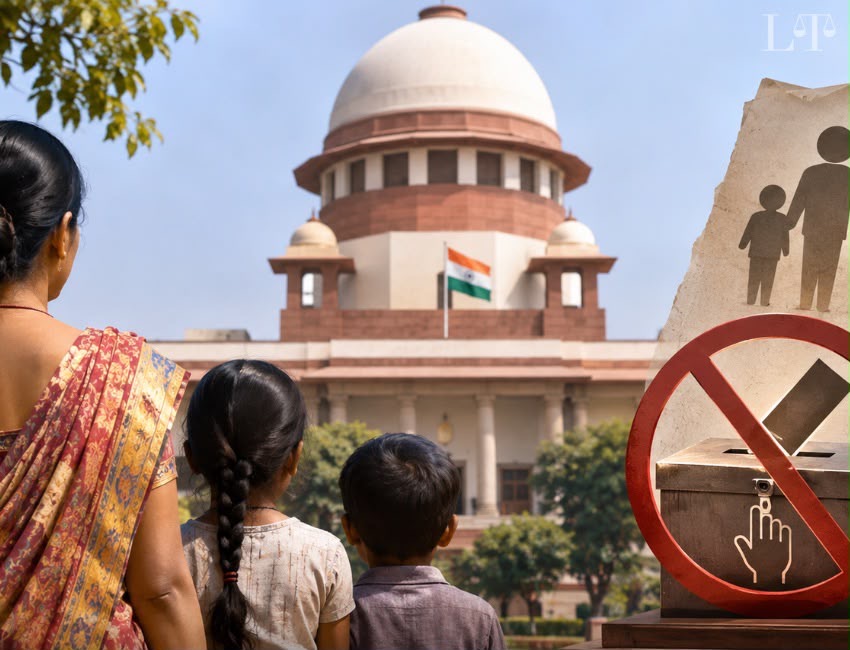
India’s changing demographic situation has brought the debate over the two-child policy back into focus. The Supreme Court has observed that laws penalising individuals for having more than two children may have become outdated due to the continuous decline in the country’s fertility rate. The observation highlights the need to reconsider population-control policies in the light of changing social and economic realities.
For several decades, population growth was considered one of India’s major challenges. However, the declining fertility rate indicates that the country is now facing a different demographic situation, requiring a fresh approach to population-related policies.
Supreme Court’s Important Observation
The Supreme Court has questioned the continued relevance of laws that disqualify individuals from contesting local body elections if they have more than two children.
The court observed that demographic conditions have changed considerably since the introduction of such restrictions. Therefore, laws framed to control population growth need to be examined in the context of present-day realities.
The bench of Justice P.S. Narasimha and Justice Alok Aradhe also considered the need to reconsider the constitutional validity of the earlier judgment in the case of Javed v. State of Haryana (2003).
The matter was referred to a larger bench for consideration of important constitutional questions.
Declining Fertility Rate in India
One of the major reasons behind the Supreme Court’s observation is the significant decline in India’s Total Fertility Rate (TFR).
The Total Fertility Rate represents the average number of children a woman is expected to have during her reproductive years.
According to the figures discussed in the matter:
- India’s fertility rate was approximately 3.02 in 2003.
- It declined to around 1.9 in 2024.
- The replacement fertility rate is generally considered to be 2.1.
A fertility rate below the replacement level indicates that, over time, the population may experience slower growth and eventually face demographic ageing.
This change raises questions about whether strict population-control measures are still justified in the present circumstances.
Background of the Two-Child Policy
The two-child policy was introduced in several states as a measure to discourage population growth. Under certain state laws, individuals having more than two children were declared ineligible to contest local body elections.
In 2003, the Supreme Court upheld the validity of the two-child norm under the Haryana Panchayati Raj Act, 1994, in the landmark Javed v. State of Haryana case.
At that time, population explosion, poverty, unemployment and pressure on limited resources were major concerns. The restriction was considered a reasonable measure to encourage smaller families.
However, India’s demographic situation has changed significantly over the years. The declining fertility rate has raised doubts about the continued necessity of such restrictions.
The Maharashtra Sarpanch Case
The issue came before the Supreme Court through a petition filed by Mangala Bhimrao Ingle, a former sarpanch from Maharashtra.
She was disqualified under Section 14(1)(j-1) of the Maharashtra Village Panchayats Act, 1959, because she had given birth to a third child.
Challenging her disqualification, she approached the Supreme Court.
The court granted interim relief by staying the effect of the Bombay High Court’s order and allowing her to continue as sarpanch.
The case also raised a larger constitutional question regarding whether having more than two children should be a valid ground for disqualifying an individual from participating in local democratic institutions.
Women’s Rights and Article 21
The Supreme Court’s observations also bring attention to women’s reproductive autonomy and constitutional rights.
Article 21 of the Indian Constitution guarantees the right to life and personal liberty. Reproductive autonomy is an important aspect of personal liberty.
Disqualifying women from elected positions because they have more than two children can raise concerns regarding gender equality, personal freedom and political participation.
The court’s observations suggest that the number of children a person has should not automatically determine their ability to participate in democratic processes.
Changing Demographic Challenges for India
The declining fertility rate may create several challenges for India’s future.
1. Ageing Population: A lower birth rate may gradually increase the proportion of elderly people, creating greater demand for healthcare and social security.
2. Declining Workforce: In the long run, a smaller younger population may affect the availability of workers in different sectors.
3. Economic Pressure: A reduction in the working-age population may create challenges for economic productivity and growth.
4. Healthcare and Pension Requirements: The government may need to increase investment in healthcare facilities, pensions and elderly care services.
These developments indicate that India’s population policy must focus not only on controlling population growth but also on maintaining demographic balance.
Way Forward
India needs to adopt a balanced and forward-looking population policy. Instead of relying on punitive restrictions, the government should focus on education, women’s empowerment, healthcare, reproductive awareness and voluntary family planning.
States should also review existing laws that may restrict democratic participation on the basis of family size.
Public policies must reflect changing demographic realities while protecting individual rights and constitutional values.
Read more like this:
- 1.5-Tonne NASA Space Observatory Re-Enters Earth’s Atmosphere; India Was Among Possible Debris Zones
- दिल्ली के चावड़ी बाजार में निर्माणाधीन 3 मंजिला इमारत ढही, कई लोगों के मलबे में दबे होने की आशंका
Conclusion
The Supreme Court’s observation on the declining fertility rate marks an important moment in India’s population-policy debate. The two-child restrictions were introduced when rapid population growth was considered a major national challenge. However, the present situation demands a fresh assessment of their relevance.
India is gradually moving towards a new demographic phase in which ageing, workforce sustainability and reproductive freedom will become increasingly important issues.
Although the larger bench will examine the constitutional questions, the broader message is clear: laws must evolve with changing social and demographic conditions. India’s future population policy should promote individual freedom, gender equality and sustainable demographic development rather than depend solely on restrictive measures.