Join
Join
 Shorts

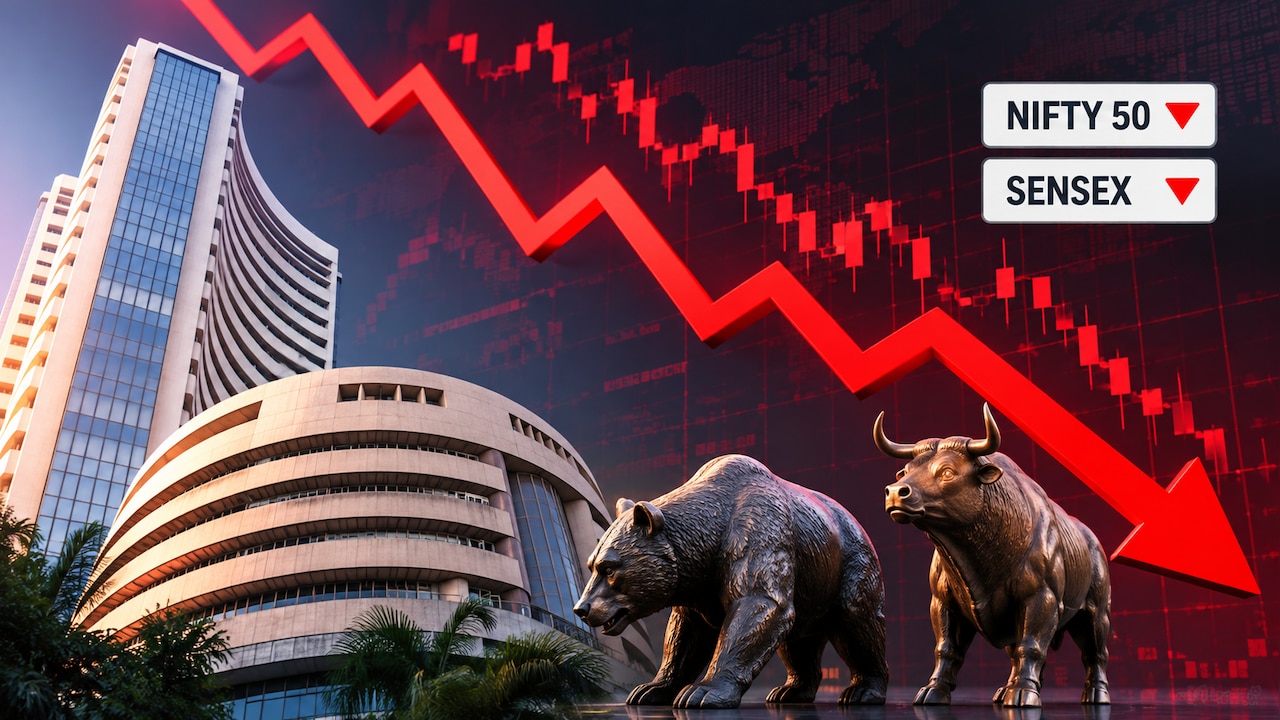
Indian equity markets came under intense selling pressure on Thursday, October 1, with benchmark indices extending their recent losing streak. The BSE Sensex fell sharply, while the NSE Nifty50 slipped below the 22,300 mark during the session as foreign investor outflows, rising US bond yields, a weak rupee and pressure on several major sectors weighed on investor sentiment.
The market had opened lower, with the Sensex at 72,192.89 and the Nifty50 at 22,543.70 at 9:15 am. The decline accelerated later in the session. According to market data, the Sensex fell as much as 952 points to an intraday low of 71,527.98, while the Nifty50 dropped as much as 319 points to 22,301.30.
The sharp fall resulted in a substantial erosion of investors’ wealth, with reports estimating that nearly ₹9.44 lakh crore was wiped out within roughly an hour as selling intensified.
Foreign investor selling remains a major concern
One of the biggest factors weighing on the Indian market is continued selling by foreign institutional investors (FIIs).
On September 30, FIIs sold Indian equities worth more than ₹10,000 crore, extending their selling streak. According to market reports, the latest outflow came amid elevated US Treasury yields, which have reduced the relative attractiveness of emerging-market assets.
Foreign selling has become a persistent feature of the Indian market in recent sessions. Reuters reported that foreign investors had withdrawn around $3.6 billion from Indian equities over the previous five sessions, taking year-to-date outflows to a record level.
Domestic institutional investors have provided some support by buying equities, but the scale of foreign selling has continued to create pressure on benchmark indices.
Nifty breaks below important levels
The Nifty50 initially traded around 22,500, but the selling intensified as the session progressed. The index subsequently approached and breached the psychologically important 22,300 zone.
The decline is significant because the Nifty has already been under pressure for several weeks. Technical levels are being closely watched by traders as the index attempts to find support after a prolonged decline.
The market is also heading towards a potentially significant weekly milestone. Both the Sensex and Nifty were on course for an eighth consecutive weekly decline, which would represent their longest such losing streak in 25 years.
Auto stocks face heavy selling
The sell-off was broad-based, with the auto sector among the major casualties.
The Nifty Auto index came under considerable pressure, with several automobile companies witnessing sharp declines. Stocks including Mahindra & Mahindra, Bajaj Auto and Maruti Suzuki were among those facing selling pressure during the session.
Concerns over automobile sales and the broader economic environment have added to pressure on the sector. The weakness was not restricted to autos, however, with metals, realty and consumer-oriented stocks also declining.
IT stocks provide some relief
While most sectors remained under pressure, information technology stocks showed relative resilience.
The IT sector benefited from softer-than-expected US inflation data, which reduced some expectations of an imminent US Federal Reserve rate hike. Reuters reported that the Nifty IT index gained around 0.9% in early trading even as the broader market remained weak.
However, the gains in technology stocks were not sufficient to offset the wider market sell-off.
Rising US bond yields add pressure
Another major concern for investors is the sharp rise in US Treasury yields.
The US 10-year Treasury yield has climbed to around 5.3%, while the 30-year yield has moved above 5.6%, levels that have not been seen for many years. Higher US yields can encourage global investors to move money towards US fixed-income assets, potentially reducing flows into emerging markets such as India.
This has added another layer of pressure at a time when foreign investors are already reducing their exposure to Indian equities.
Rupee remains under pressure
The Indian rupee has also weakened amid concerns over higher crude prices and global interest rates.
The currency moved past the ₹96-per-dollar level, increasing concerns about India’s import costs. A weaker rupee can be particularly important for an economy that depends heavily on imported crude oil.
At the same time, Brent crude was trading close to $98 per barrel, adding to concerns about inflation and corporate margins.
Global cues remain mixed
Global markets have provided little support to Indian equities. Asian markets were mixed on Thursday, while US markets had ended on a subdued note.
Japan’s Nikkei performed relatively strongly, while South Korea’s Kospi and Australia’s benchmark were lower. China and Hong Kong markets were closed for a holiday.
Investors are also monitoring developments surrounding US-Iran relations and the potential impact on crude-oil supply. Any improvement in geopolitical tensions could provide some relief to energy prices, but uncertainty remains.
Read more like this:
- SIR पर बॉम्बे हाई कोर्ट की सख्त टिप्पणी: ‘इलेक्टोरल सिस्टम सस्पेंड कर दिया’, सॉफ्टवेयर नहीं कानून के मुताबिक काम करने को कहा
- SIR Row: Rahul Gandhi Questions Gyanesh Kumar’s Legal Immunity, Links It to Election Commission Controversy
What investors are watching
The immediate focus for market participants is whether the Sensex and Nifty can stabilise after the sharp intraday decline. Investors are also monitoring foreign fund flows, the rupee-dollar exchange rate, US bond yields and crude oil prices.
The next few sessions could remain volatile as global macroeconomic factors continue to influence sentiment.
For investors, the current market movement highlights the importance of distinguishing between short-term market volatility and longer-term fundamentals. Individual stocks and sectors may respond differently depending on earnings expectations, valuations and exposure to global markets.
With the Sensex witnessing a steep intraday decline and the Nifty approaching the 22,300 level, October has begun on a highly volatile note for Indian equities. The combination of foreign selling, elevated bond yields, currency weakness and pressure on cyclical sectors remains the key backdrop for the market as investors await clearer signals on global interest rates, crude prices and capital flows.