Join
Join
 Shorts

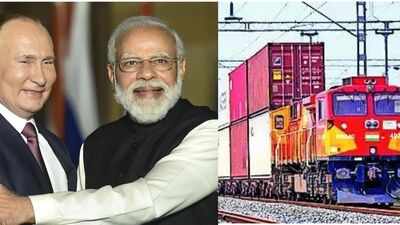
Russia has floated an ambitious proposal to explore a direct railway connection linking its transport network with the Indian Ocean and, potentially, India, in a move that could reshape trade connectivity between Moscow and New Delhi. Russian Deputy Prime Minister Marat Khusnullin has said that the feasibility of such a rail corridor should be examined as Moscow looks for alternatives to maritime routes exposed to geopolitical disruptions.
The proposal comes at a time when global shipping routes are facing heightened uncertainty, particularly around the Strait of Hormuz. Moscow believes that developing alternative land-based corridors could reduce the risks associated with critical maritime chokepoints and create new options for transporting goods between Russia and South Asia.
The statement does not amount to a final decision to build the railway. Rather, it signals Moscow’s interest in examining the feasibility of a new overland transport corridor that could eventually provide Russia with an alternative route towards the Indian Ocean and India.
Why Russia is looking beyond traditional sea routes?
Russia’s proposal is closely linked to the changing geopolitical environment surrounding international trade.
The Strait of Hormuz is one of the world’s most strategically important maritime passages. A significant proportion of global oil and liquefied natural gas shipments passes through the waterway. Any prolonged disruption can therefore affect shipping costs, energy markets and global supply chains.
The Bosphorus is another important maritime chokepoint for Russian trade. Disruptions or restrictions affecting these routes can increase uncertainty for exporters and importers.
The proposed Russia-India railway would not necessarily replace maritime trade. Instead, it could function as an additional route, allowing certain categories of cargo to move overland when sea routes become expensive, congested or vulnerable to geopolitical disruptions.
Possible route through Central and South Asia
The most striking aspect of the Russian proposal is the possible route through several countries.
Khusnullin identified Turkmenistan, Iran, Afghanistan and Pakistan as possible transit countries. From there, the corridor could provide onward access towards the Indian Ocean and India.
Such a route would effectively connect parts of Russia and Central Asia with South Asia through a continuous overland transport network.
Could India benefit from the proposed corridor?
For India, a functioning overland connection with Russia could provide another avenue for trade.
India and Russia have traditionally maintained close economic and strategic relations. Bilateral trade has expanded significantly in recent years, particularly following changes in global energy markets and India’s increased imports of Russian crude oil.
A direct or relatively efficient land corridor could potentially facilitate the movement of machinery, industrial goods, agricultural products, raw materials and other commodities
A possible complement to the North-South corridor
The idea also has significance in the context of existing efforts to develop alternative transport routes between India and Russia.
One of the most prominent initiatives is the International North-South Transport Corridor (INSTC), which seeks to connect India with Russia through Iran and the Caspian region using a combination of rail, road and maritime transport.
The newly floated railway proposal could potentially complement such existing connectivity efforts by creating additional land-based options.
Geopolitical challenges remain
Despite its potential, the proposed route would pass through one of the most geopolitically complex regions in the world.
The inclusion of Pakistan is particularly significant.
India and Pakistan have a difficult bilateral relationship, and any railway corridor connecting the two countries would require substantial political coordination. Cross-border infrastructure projects involving the two countries have historically been affected by security and diplomatic tensions.
Afghanistan presents another challenge. Although it occupies a strategically important position between Central and South Asia, its political and security situation could complicate large-scale infrastructure development.
Iran, meanwhile, would be a crucial link in the proposed network. The country already plays an important role in several regional connectivity initiatives, including India’s engagement with the Chabahar port.
The success of any Russia-India railway corridor would therefore depend not only on engineering and investment but also on sustained diplomatic cooperation among multiple governments.
Infrastructure and financial questions
Building a new railway across such a vast region would require enormous investment.
The proposal currently does not include a detailed cost estimate, construction schedule or financing structure. There is also no confirmed decision from India, Pakistan, Afghanistan, Iran or Turkmenistan to participate in such a project.
Existing railway infrastructure would need to be assessed to determine whether it could accommodate additional international freight.
Customs and border procedures would also need to be streamlined. For international freight trains to be competitive with shipping, cargo would have to move across borders with minimal delays.
Railway gauge differences could present another technical issue. Countries along the potential route may use different railway standards, requiring transshipment or gauge-conversion solutions
Trade security is becoming a strategic priority
The proposal reflects a broader change in how major economies view transport infrastructure.
For decades, international trade relied heavily on maritime shipping because of its relatively low cost and enormous capacity. But geopolitical conflicts, sanctions, port disruptions and attacks on shipping have highlighted the vulnerability of major sea lanes.
Governments are therefore increasingly interested in supply-chain diversification.
Russia’s interest in a railway towards the Indian Ocean fits into this larger trend.
Read more like this:
- देसी गायों की नस्ल बचाने के लिए सरकार की बड़ी पहल, जानिए Rashtriya Gokul Mission के बारे में
- BharatNet Project क्या है: कैसे देश के हर कोने तक पहुंचेगा नेट?
- FCRA संशोधन विधेयक पर घमासान: संसद में केंद्र को घेरने की तैयारी में विपक्ष, जानिए क्यों विदेशी फंडिंग कानून पर उठ रहे सवाल
What does ‘viable’ mean at this stage?
The Russian proposal has been described in reports as a viable option, but that should not be interpreted as confirmation that a direct railway between Russia and India has been approved.
Khusnullin’s comments indicate that Moscow believes routes providing access to India are worth exploring. The immediate step would therefore be a feasibility assessment rather than construction.
Such a study would need to examine the route, cost, security conditions, existing railway infrastructure, transit agreements and expected freight volumes.
Conclusion
Russia’s proposal to explore a railway connection towards the Indian Ocean marks a significant development in Eurasian connectivity planning. Russian Deputy Prime Minister Marat Khusnullin has argued that alternative routes should be examined to reduce the risks associated with maritime chokepoints such as the Bosphorus and Strait of Hormuz. Possible routes could pass through Turkmenistan, Iran, Afghanistan and Pakistan before providing access towards India.
The proposal remains at the feasibility stage, and there is no confirmed construction plan, financing agreement or timeline. Major challenges—including infrastructure gaps, security concerns, border arrangements and India-Pakistan relations—would have to be resolved.
Yet the idea is strategically significant. At a time when geopolitical tensions are forcing countries to rethink supply chains and trade routes, a Russia-India overland rail corridor could eventually provide an important alternative to maritime transport.
Whether it becomes a functioning railway or remains a strategic proposal will depend on economics, engineering and, perhaps most importantly, diplomacy. For now, Moscow’s message is clear: as global trade routes become more vulnerable, Russia wants to explore every viable pathway that can strengthen its connection with India and the Indian Ocean.