Join
Join
 Shorts

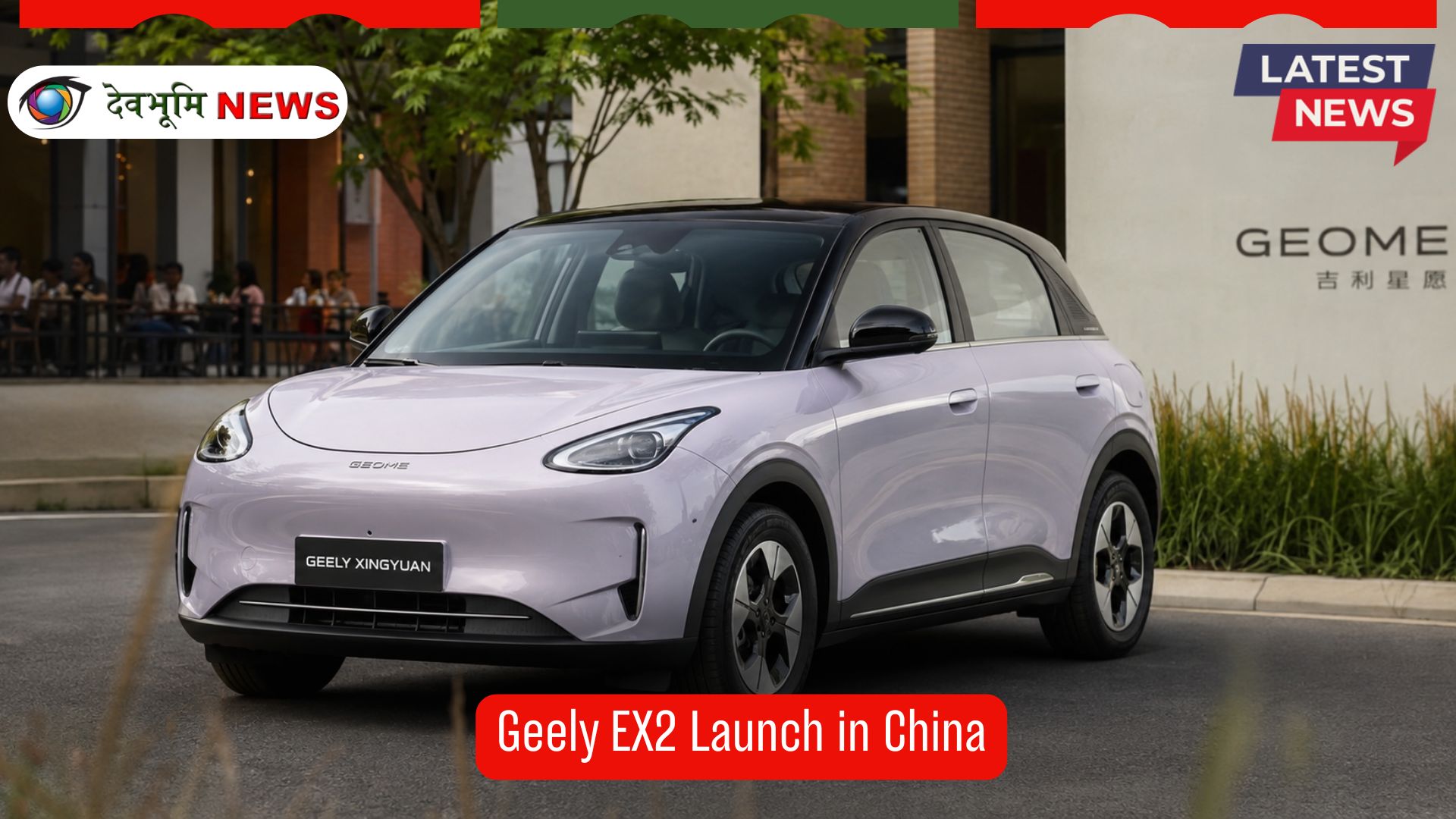
The Geely EX2 launch in China may sound like just another electric car headline in a world already overflowing with battery-powered buzzwords, but this little hatchback is quietly rewriting the rules of affordable mobility.
And honestly? That’s what makes it fascinating.
Because while the global auto industry spent years convincing people that EVs needed giant touchscreens, spaceship acceleration, and prices that require emotional recovery afterward, Geely took a different route.
It built a small electric hatchback that normal people could actually buy.
Not dream about.
Not configure online for fun.
Actually buy.
Known domestically as the Geely Xingyuan, the EX2 first launched in China on October 9, 2024, before exploding into one of the country’s biggest automotive success stories throughout 2025. By the end of that year, the car reportedly crossed roughly 465,000 units in sales, outperforming major rivals including the Tesla Model Y and BYD Seagull in China’s fiercely competitive EV market.
That achievement alone deserves attention.
Because China’s EV market is not forgiving. It’s basically automotive survival mode with ambient lighting.
What Is the Geely EX2?
The Geely EX2 is a compact electric hatchback developed primarily for urban mobility, affordability, and high-efficiency commuting.
In China, the car is officially known as the Geely Xingyuan and belongs to the Geome lineup — a brand architecture that evolved from Geely’s former Geometry EV division. While the Geome identity now operates under Geely Galaxy’s broader retail and distribution network, the vehicle itself still carries dedicated Geome badging, especially around the C-pillar area.
That distinction matters because Geely is carefully separating mainstream affordable EVs from its more premium Galaxy-branded offerings.
Think of it like a restaurant chain that quietly sells the best food from the cheapest menu item.
The EX2 also stands out mechanically because it offers several features rarely seen in affordable EVs:
- Rear-wheel-drive layout
- Multi-link independent rear suspension
- Liquid-cooled battery technology
- Fast-charging capability
- Surprisingly refined cabin packaging
In the world of budget electric hatchbacks, that’s basically overachieving.
Why the EX2 Became a Sales Phenomenon
The success of the EX2 didn’t happen by accident.
Geely understood something many automakers still struggle to accept: most people don’t want futuristic experiments. They want transportation that feels practical, affordable, and stress-free.
The EX2 delivers exactly that.
Its popularity surged throughout 2025 thanks to several factors:
- Aggressive pricing
- Modern technology
- Compact urban-friendly dimensions
- Efficient battery management
- Premium ride quality for the segment
- Attractive styling without looking overly futuristic
And perhaps most importantly, the car doesn’t constantly remind you that it’s electric.
That sounds strange, but it matters.
Many EVs still feel like they were designed by engineers trying to win arguments on LinkedIn. The EX2 simply behaves like a good car first and an EV second.
That balance resonates with buyers.
Especially younger city buyers who care more about practicality and low ownership costs than 0–100 km/h acceleration figures they’ll use exactly twice.
Battery, Range, and Charging Specifications
This is where the Geely EX2 launch in China becomes particularly impressive for the price category.
Unlike many exaggerated EV rumors floating around online, the actual production specifications are more grounded — but still highly competitive.
Verified Battery Configurations
| Variant | Battery Capacity | CLTC Range |
|---|---|---|
| Base Model | 30.12 kWh LFP | 310 km |
| Higher Variant | 40.16 kWh LFP | 410 km |
The larger 40.16 kWh battery is currently the highest available configuration for the platform, typically associated with the “Explorer Edition” trims.
And honestly, 410 km CLTC is already more than enough for the audience this car targets.
Realistically, buyers can expect around:
- 260–320 km in mixed real-world driving
- Excellent city efficiency
- Low running costs
- Minimal charging anxiety for daily use
That last part matters more than marketing departments admit.
Because EV ownership isn’t really about maximum range anymore. It’s about confidence.
People want to know they can:
- Commute comfortably
- Handle traffic jams
- Run errands
- Visit relatives without panic-calculating battery percentages like cryptocurrency investors
The EX2 seems engineered around that exact mindset.
Charging Performance
The EX2 supports DC fast charging with charging speeds peaking around 70 kW.
Geely claims:
- 30% to 80% charging in approximately 21–25 minutes
- Liquid-cooled battery thermal management
- Improved charging stability in hot climates
For an entry-level EV, that’s genuinely solid.
Especially because some budget EV rivals still treat thermal management like an optional personality trait.
Why the RWD Platform Matters
One of the most interesting aspects of the EX2 is its rear-wheel-drive platform.
Most affordable hatchbacks use front-wheel-drive layouts because they’re cheaper and easier to package. Geely choosing RWD immediately changes the driving character of the vehicle.
Benefits include:
- Better weight distribution
- Cleaner steering feel
- Improved traction balance
- More stable handling dynamics
And then there’s the suspension setup.
The EX2 uses a multi-link independent rear suspension system — something usually reserved for more expensive cars.
Most rivals in this segment rely on torsion beam setups because they reduce cost.
Now, to be fair, most regular buyers won’t walk into a showroom saying:
“Excuse me, does this vehicle feature sophisticated rear suspension geometry?”
But they absolutely notice:
- Ride comfort
- Stability over rough roads
- Cabin composure
- Reduced body movement
People don’t need to understand engineering to feel refinement.
Interior and Technology Features
The EX2’s interior focuses heavily on digital simplicity and space efficiency.
Highlights include:
- Large central infotainment display
- Minimalist dashboard layout
- Smart storage solutions
- Spacious rear seating area
- Flyme Auto software integration
- Voice command support
- Connected vehicle features
The overall design philosophy feels intentionally clean rather than aggressively futuristic.
That’s a smart move.
Some modern EV interiors now resemble luxury airport lounges designed by people who believe physical buttons are morally wrong.
The EX2 avoids that mistake.
Instead, it balances technology with usability.
Which is surprisingly refreshing in 2026.
Geome vs Galaxy: Understanding the Branding
The branding situation around the EX2 can get confusing, mainly because Geely has been restructuring its EV portfolio aggressively.
Here’s the simple version:
- Geometry was Geely’s earlier EV-focused brand
- Geome evolved from that structure
- Galaxy became Geely’s larger premium-focused EV ecosystem
- The EX2/Xingyuan is technically a Geome product
- However, it benefits from Galaxy’s distribution and sales network
That’s why some reports incorrectly label the car as a pure Galaxy model.
In reality, Geely is blending the ecosystems operationally while still maintaining different branding identities.
Automotive companies love doing this.
It keeps marketing teams employed.
Global Expansion Plans for 2026
While the EX2 launched in China back in late 2024, 2026 is expected to become its major global expansion phase.
Several international markets are either preparing for launch or actively evaluating the platform:
- Australia
- Thailand
- South Africa
- Vietnam
- Philippines
- Selected Latin American markets
There’s also growing speculation around additional right-hand-drive export programs.
And honestly, the timing makes sense.
Fuel prices remain volatile globally, urban congestion keeps worsening, and consumers increasingly want smaller vehicles that are easier to own and cheaper to operate.
The EX2 fits that reality almost perfectly.
Not everybody wants a giant electric SUV that weighs as much as small architecture.
Sometimes people simply want a compact car that:
- Parks easily
- Charges quickly
- Costs less to maintain
- Doesn’t look embarrassing
That last requirement matters more than manufacturers like admitting.
Rivals the EX2 Wants to Beat
The EX2 competes directly against several rapidly growing affordable EVs:
- BYD Seagull
- Wuling Bingo
- Dongfeng Nammi
- Leapmotor T03
- MG Comet EV in export comparisons
However, Geely’s strongest advantage may actually be chassis sophistication.
Features like:
- Rear-wheel drive
- Multi-link rear suspension
- Liquid battery cooling
…are exceptionally uncommon in this price segment.
And that could become the EX2’s long-term differentiator as buyers become more educated about EV ownership.
Because eventually, people stop shopping purely for screens and start caring about how cars actually feel to live with.
That’s usually when the genuinely well-engineered products start winning.
Read more
- SC Flags NEET UG 2026 Paper Leak Concerns: सुप्रीम कोर्ट ने NTA से मांगा जवाब, छात्रों में बढ़ी चिंता
- भारत को मिलेगा 114 नए राफेल फाइटर जेट्स: IAF की ताकत बढ़ाने की दिशा में बड़ा कदम
Final Thoughts
The Geely EX2 launch in China represents something bigger than just another affordable electric hatchback.
It reflects the moment EVs started becoming normal.
Not luxury experiments.
Not political statements.
Not giant technological flexes.
Just good cars.
And in many ways, that’s the most disruptive thing of all.
The EX2 succeeds because it understands modern urban life:
- Expensive fuel
- Crowded roads
- Tight parking spaces
- Rising ownership costs
- Buyers who want practicality without sacrifice
Geely didn’t reinvent transportation here.
It simply built an EV people genuinely want to own.
Sometimes, that’s enough to change an industry.