Join
Join
 Shorts

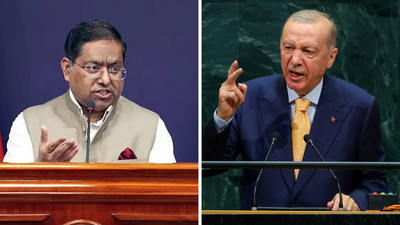
India has rejected Turkish President Recep Tayyip Erdogan’s latest reference to Jammu and Kashmir at the United Nations General Assembly, calling the remarks “unwarranted” and reiterating that no external party has any role in matters concerning India’s territorial integrity and sovereignty.
The response from New Delhi came after Erdogan referred to Kashmir during his address to the 81st session of the United Nations General Assembly in New York on September 22. The Turkish president said that disputes in South Asia, including the Kashmir issue, should be addressed through dialogue within the framework of the UN Charter and relevant resolutions.
India’s Ministry of External Affairs responded to the remarks during its regular briefing on September 29.
India: ‘No external party has any locus standi’
MEA spokesperson Randhir Jaiswal said India rejected the references made by the Turkish president to India and the Union Territory of Jammu and Kashmir.
Jaiswal described the comments as “unwarranted” and said the issue relates to India’s territorial integrity and sovereignty. He added that “no external party has any locus standi” on the matter.
The phrase “locus standi” refers to recognised standing or authority to intervene in a particular matter. By using the term, New Delhi reiterated its longstanding position that third countries should not seek to play a role in the Kashmir issue.
India has consistently maintained that issues between India and Pakistan should be resolved bilaterally and has opposed international mediation on Kashmir.
What did Erdogan say at the UN?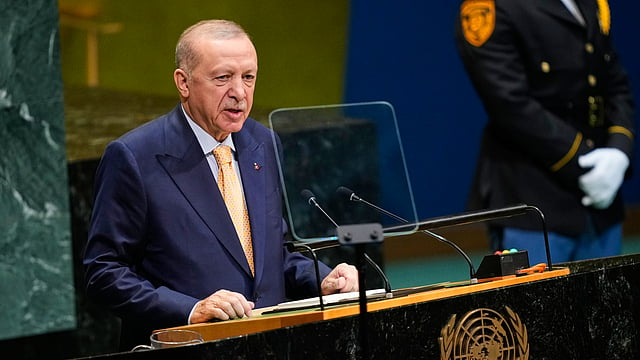
During his UNGA address, Erdogan said disputes in South Asia, including Kashmir, should be dealt with through dialogue and within the framework of the UN Charter and relevant resolutions.
His comments were made in the presence of Pakistan Prime Minister Shehbaz Sharif, giving the remarks additional diplomatic significance in the context of India-Pakistan relations.
Erdogan has raised the Kashmir issue at international forums several times in recent years. His latest remarks therefore represent a continuation of Ankara’s stated position rather than a new policy shift.
New Delhi, however, has repeatedly objected to such references, arguing that outside intervention is not appropriate.
India’s longstanding position on Kashmir
India’s position is that Jammu and Kashmir is a matter concerning the country’s sovereignty and territorial integrity. New Delhi has also maintained that outstanding issues with Pakistan should be addressed through direct bilateral engagement.
India frequently cites the 1972 Simla Agreement, under which India and Pakistan committed themselves to resolving differences through peaceful means and bilateral negotiations.
Following the April 2025 Pahalgam terror attack and the subsequent military escalation between India and Pakistan, New Delhi again emphasized that it would deal with Islamabad directly on issues concerning Jammu and Kashmir.
Against this backdrop, Erdogan’s call for dialogue within a UN framework has again brought the differences between India and Türkiye into focus.
Türkiye-Pakistan ties add diplomatic context
The latest dispute also comes against the backdrop of closer strategic relations between Türkiye and Pakistan.
Türkiye has maintained strong political ties with Islamabad and has repeatedly expressed support for Pakistan’s position on Kashmir. India has viewed such interventions critically, particularly when they involve international forums.
In August 2026, Türkiye, Pakistan and Saudi Arabia also signed the Mecca Joint Defence Agreement, under which the three countries committed to enhanced security cooperation. The development has added another layer to the evolving strategic relationships in the region.
India’s relations with Türkiye have consequently faced periodic diplomatic differences over Ankara’s position on Kashmir and its engagement with Pakistan.
Kashmir references have appeared in Erdogan’s UN speeches before
This is not the first time Erdogan has spoken about Kashmir at the United Nations. He also raised the issue during his UNGA address in 2019, after India revoked Jammu and Kashmir’s special constitutional status under Article 370.
Since then, New Delhi has repeatedly rejected Erdogan’s statements and maintained that Kashmir is an internal matter concerning India’s sovereignty.
Erdogan again referred to Kashmir at the UN General Assembly in 2025, drawing another response from India. His latest comments show that the issue continues to be part of Türkiye’s public diplomatic messaging at major international forums.
Read more like this:
- JEE-NEET Exams Twice a Year: साल में दो बार होंगी JEE, NEET और CUET जैसी प्रवेश परीक्षाएं, शिक्षा मंत्रालय ने तैयार किया ड्राफ्ट
- Jaishankar on India-US Ties: ‘Lack of Empathy’ Over Terror Concerns, Trade Differences Create Fr
Diplomatic disagreement, but wider ties continue
Despite differences over Kashmir, India and Türkiye maintain diplomatic and economic relations. The two countries have interests in trade, investment, tourism and broader regional cooperation.
The latest exchange, therefore, represents a specific disagreement over foreign-policy and sovereignty issues rather than a formal break in bilateral relations.
For New Delhi, the central message remains unchanged: Kashmir-related matters involving India and Pakistan should not be subject to third-party intervention. Türkiye, meanwhile, continues to advocate dialogue and has publicly raised the issue at international forums.
The episode once again highlights the contrasting diplomatic positions of India and Türkiye on Kashmir, as well as the broader geopolitical dynamics involving India, Pakistan and Türkiye.