Join
Join
 Shorts


Canadian poet, writer, translator and classical scholar Anne Carson has been awarded the 2026 Nobel Prize in Literature, one of the world’s most prestigious literary honours. The Swedish Academy announced the award on October 8, 2026, recognising Carson for her distinctive contribution to contemporary literature and her innovative engagement with classical traditions.
The Swedish Academy honoured Carson “for her bold and inventive oeuvre that, in playful dialogue with the classical tradition, has created new forms for contemporary literature.” The citation highlights the originality of her writing and her ability to connect ancient literature with modern forms of artistic expression.
Who Is Anne Carson?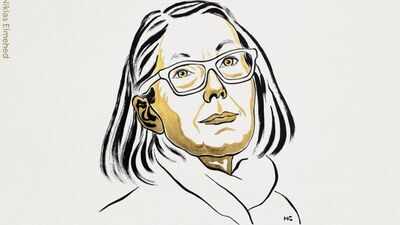
Anne Carson was born in Toronto, Canada, in 1950. She developed a deep interest in ancient Greek literature and classical languages, which later became a defining feature of her literary career. She studied Classics and went on to build a career that combined academic scholarship, teaching, translation and creative writing.
Carson is known for refusing to remain within the boundaries of a single literary genre. Her work frequently combines poetry, prose, essays, translation, drama and scholarship. This unusual approach has made her one of the most distinctive voices in contemporary literature.
She has also taught Classics at universities and spent decades exploring the relationship between language, history and literature. Her academic background has strongly influenced her creative work.
Anne – Unique Literary Style
One of the most remarkable features of Carson’s writing is her ability to bring ancient and modern worlds together. Greek mythology, classical poetry and ancient philosophy often appear in her work, but she does not simply reproduce old stories. Instead, she transforms them and uses them to explore modern experiences such as love, desire, loneliness, identity and loss.
Her writing often crosses the traditional boundaries between poetry and fiction. She may combine scholarly commentary with poetic passages or use ancient characters to tell contemporary stories. This experimental style is a major reason the Swedish Academy described her literary work as “bold and inventive.”
Major works of Anne Carson
Anne Carson has produced an extensive body of work across several literary forms. One of her best-known books is Autobiography of Red, published in 1998. The verse novel takes inspiration from an ancient Greek poem by Stesichorus and reimagines the mythological figure Geryon as a modern young character.
Another important work is The Beauty of the Husband, which explores relationships and separation through an unusual structure combining poetry and narrative. Carson has also written works such as Eros the Bittersweet, Decreation, Red Doc>, Nox and Float.
Her translations of ancient Greek literature have also received considerable attention. Translation, for Carson, is not simply the transfer of words from one language to another; it becomes another form of creative writing and interpretation.
Recognition From the Swedish Academy
The Nobel Prize committee’s recognition focuses particularly on Carson’s relationship with the classical tradition. Instead of treating ancient literature as something distant or outdated, Carson brings it into conversation with the concerns of modern readers.
Her work demonstrates how old myths, poems and ideas can be reshaped to address contemporary questions. The Academy has highlighted the way her writing creates new literary possibilities by combining different forms and traditions.
Carson’s Reaction to the Nobel Prize
Carson was reportedly in Iceland when she received the news of her Nobel Prize. Ingrid Carlberg, permanent secretary of the Swedish Academy, said Carson was surprised by the announcement and very happy. Carson has held Icelandic citizenship since 2022 while remaining closely associated with Canada and its literary tradition.
The 2026 Nobel Prize in Literature comes with an award of 12 million Swedish kronor, approximately US$1.2 million. The Nobel ceremony is scheduled to take place in Stockholm in December.
Significance for Canadian Literature
Carson’s achievement is an important moment for Canadian literature. Her Nobel Prize places another Canadian writer among the world’s most respected literary figures. She joins a distinguished tradition that includes Canadian Nobel laureate Alice Munro, who received the Literature Prize in 2013.
Carson’s success also demonstrates the international importance of experimental literature. Her work shows that poetry and literary scholarship can interact with mythology, history and contemporary life in unexpected ways.
Read more like this:
- SIR के समर्थन में 42 रिटायर्ड जजों का देश के नाम खुला पत्र, विपक्ष के प्रदर्शन पर उठाए सवाल
- No MDR on UPI from October 15? Government Considers Delaying Rollout of Fees
Conclusion
Anne Carson’s selection as the 2026 Nobel Prize laureate in Literature celebrates a remarkable literary career built on experimentation, scholarship and imagination. Her ability to connect ancient Greek traditions with contemporary experiences has produced a body of work unlike that of many other modern writers.
By challenging conventional ideas about poetry, fiction and translation, Carson has expanded the possibilities of literature. Her Nobel Prize recognises not only her achievements as a Canadian writer but also her lasting influence on contemporary literary culture.
Her journey from a scholar of classical literature to a Nobel laureate demonstrates the enduring power of language—and shows that ancient stories can continue to find new meaning in the modern world.