Join
Join
 Shorts

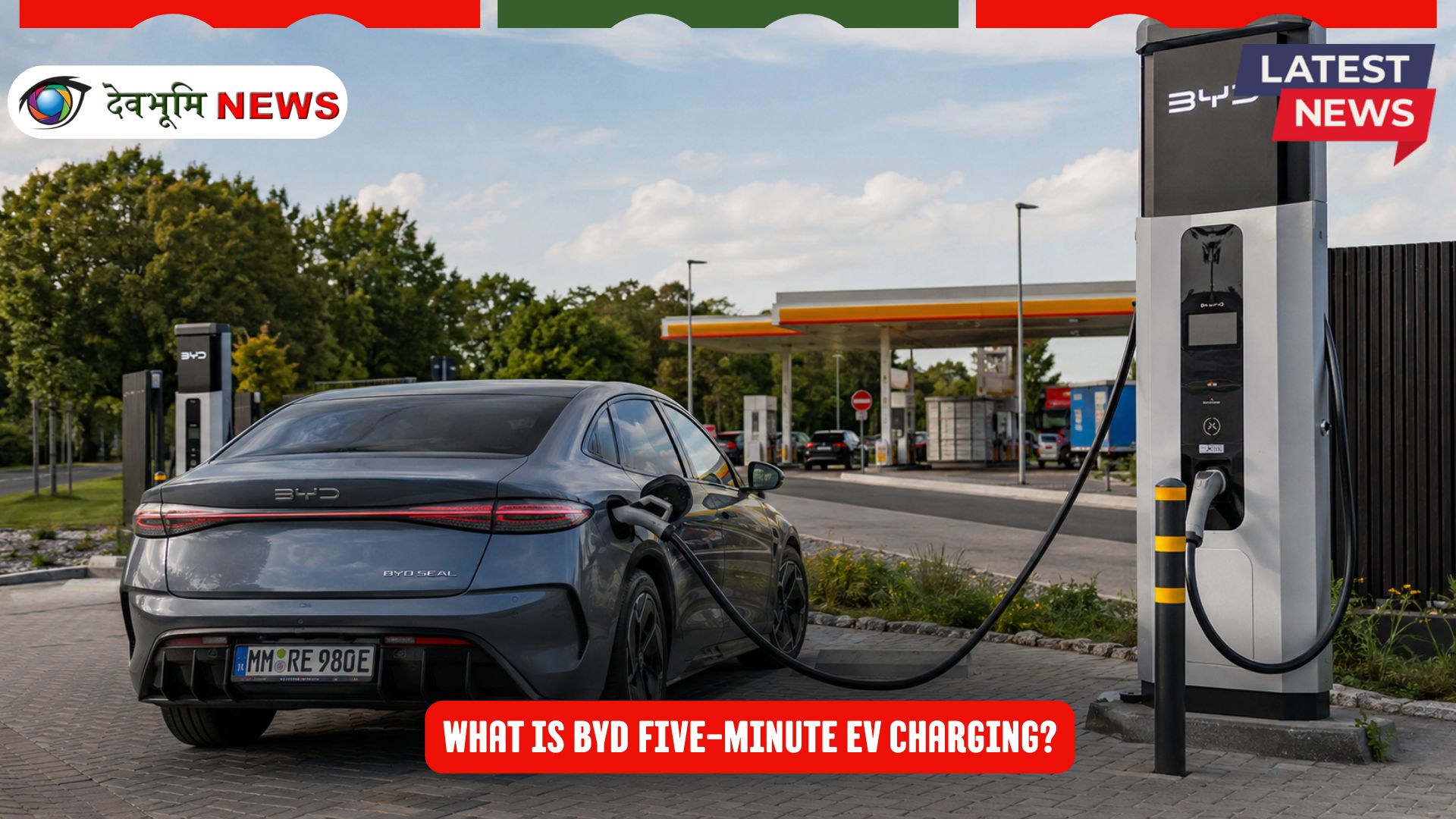
BYD five-minute EV charging is one of those phrases that sounds like it escaped from a tech keynote after drinking three espressos. But unlike many “future of mobility” promises, this one has real hardware behind it.
BYD’s latest Flash Charging technology is designed to charge compatible electric vehicles from around 10% to 70% in roughly five minutes. In simple words, that means the boring coffee-stop EV charge could become closer to a petrol-pump pause. Pull in, plug in, stretch your legs, argue with the payment app for emotional balance, and you are almost ready to go.
The technology is built around BYD’s high-voltage electric architecture, its second-generation Blade Battery, and ultra-powerful Flash Chargers capable of delivering up to 1,500 kW. That number is not just big; it is “your home charger just looked away in embarrassment” big.
For context, many current public fast chargers operate between 50 kW and 350 kW. BYD’s Flash Charging system pushes the conversation into megawatt territory. The company says the system can deliver petrol-like refuelling convenience, which has long been the dream for EV makers and the complaint department for EV skeptics.
How BYD Flash Charging actually works
The basic idea behind BYD five-minute EV charging is easy to understand: send a huge amount of power into the battery very quickly without overheating it, damaging it, or turning the charging station into a science experiment with smoke.
To do that, BYD uses a high-voltage setup and specially designed battery chemistry. The company’s earlier Super e-Platform brought a 1,000V architecture, 1,000A current support, and a claimed charging speed of about 2 km of range per second. The newer Flash Charging system goes even further, with charging power rated up to 1,500 kW on compatible vehicles.
But raw power is only half the story. The clever part is managing heat, current flow, battery safety, and grid demand at the same time. Ultra-fast charging is not just about shouting “more electricity!” at a battery. Batteries are moody. Push them too hard, and they heat up, degrade faster, or simply refuse to play along.
BYD’s solution includes high-speed ion channels inside the battery, liquid-cooled charging hardware, and energy-storage-supported charging stations. That last part matters a lot. Instead of pulling the entire power demand from the grid instantly, the station can use on-site battery storage as a buffer. Think of it like filling a water tank slowly overnight and then releasing a powerful stream when needed.
That makes the system more realistic for highways, dealerships, motorway services, and busy city charging hubs where direct grid upgrades can be expensive and painfully slow.
Blade Battery 2.0: the real hero behind the speed
The charger gets the spotlight, but the battery is doing the heavy lifting. BYD’s Blade Battery has already earned a reputation for safety and durability, especially because it uses lithium iron phosphate chemistry, commonly known as LFP.
LFP batteries are usually praised for being safer and more cost-effective than nickel-heavy battery chemistries. The trade-off has often been lower energy density and slower charging compared with some premium battery packs. BYD is trying to kick that old stereotype into the recycling bin.
Blade Battery 2.0 is designed to accept ultra-high charging power while keeping heat and resistance under control. BYD says the battery can go from 10% to 70% in about five minutes and from 10% to 97% in around nine minutes under ideal conditions. Even in extreme cold, the company claims the charge time penalty is surprisingly small.
That cold-weather point is important. EV owners know winter can be cruel. Range drops, charging slows, and the car’s battery sometimes behaves like it has chosen hibernation as a lifestyle. If BYD’s claims hold up in real-world conditions, this could be a huge step forward for markets where winter is more than just a Netflix aesthetic.
Why this matters for everyday EV buyers
Range anxiety has always been the villain in the EV story. It wears many masks: “What if I run out of charge?”, “What if the charger is broken?”, “What if I need 45 minutes on a highway trip?”, and the classic family-road-trip horror line, “Dad, are we still charging?”
BYD five-minute EV charging attacks that fear directly. If EV charging can become nearly as quick as filling petrol or diesel, one of the biggest psychological barriers to electric cars starts to fade.
This does not mean every EV problem disappears overnight. Charging networks still need reliability. Payment systems still need to stop behaving like puzzle rooms. Cities still need more chargers. Apartment owners still need practical home-charging options. But five-minute charging changes the emotional equation.
The deeper thought here is simple: technology becomes mainstream when people stop thinking about it. Nobody wakes up and says, “I hope my petrol pump experience is smooth today.” It just works most of the time. EVs need to reach that same invisible convenience. BYD’s Flash Charging technology is a serious attempt to make charging feel boring — and boring, in this case, is beautiful.
The Europe and UK rollout
BYD is not treating Flash Charging as a lab-only trick. The company has already outlined major infrastructure plans in China and is now moving toward Europe and the UK.
Reports suggest BYD wants thousands of Flash Chargers across Europe, with Germany and the UK among the early focus markets. In Britain, early plans point toward chargers at high-traffic locations, including motorway routes, dealerships, retail areas, and possibly fuel-station-style hubs.
There is also early pricing guidance. BYD UK leadership has indicated a target of below 50 pence per kWh for Flash Charging in the UK. If that becomes reality, it could be highly competitive against many existing ultra-rapid charging networks.
That pricing matters because fast charging has sometimes felt like ordering popcorn at a cinema: convenient, yes, but your wallet leaves the building with trust issues. If BYD can combine very high charging speeds with sensible pricing, it will not just be selling cars. It will be selling confidence.
The catch: not every EV can use the full speed
Now for the small print, because every revolution comes with a terms-and-conditions page.
BYD’s Flash Chargers may be physically compatible with many EVs using standard CCS connectors, depending on the market and station setup. However, only vehicles designed to handle the full 1,500 kW charging rate can take advantage of the headline five-minute performance.
That means your regular EV will not magically charge at 1,500 kW just because it plugs into a Flash Charger. The car’s battery, voltage architecture, cooling system, software, and charging hardware all need to support those speeds.
At the moment, the full benefit is expected mainly on newer BYD and Denza models equipped with the latest Blade Battery technology. The Denza Z9GT has been highlighted as an early European model capable of using the technology properly.
So yes, BYD five-minute EV charging is real, but it is not universal yet. It is more like 5G when it first arrived: impressive, exciting, and slightly dependent on whether your device and location are invited to the party.
Should Tesla, Hyundai, and others be worried?
Worried? Maybe. Awake? Definitely.
Tesla built much of its EV advantage not just on cars, but on the Supercharger network. That network made Tesla ownership feel easier than many rival EVs. BYD appears to have learned the same lesson: batteries win headlines, but infrastructure wins habits.
If BYD can build a reliable Flash Charging network in China and Europe, it gains a major strategic advantage. It can tell buyers, “Our cars are not only cheaper or better equipped; they are also easier to live with.”
That is a powerful argument.
Hyundai, Kia, Porsche, Mercedes-Benz, XPeng, Nio, and other fast-charging players are not standing still either. Many already support 800V architectures and impressive charging speeds. But BYD’s 1,500 kW claim moves the benchmark higher and turns charging speed into a fresh battleground.
The next EV war may not be about who has the biggest screen or the most dramatic ambient lighting. It may be about who can add hundreds of kilometres before your takeaway coffee cools down.
What it could mean for India
For India, BYD five-minute EV charging is exciting but still distant. India’s EV charging infrastructure is improving, but ultra-high-power charging at this scale needs major investment, grid planning, land access, and compatible vehicles.
Still, the technology matters for India in the long run. Highway charging is one of the key missing pieces for mass EV adoption here. Indian buyers are practical. They do not just ask, “How much range does it have?” They ask, “What happens when I go from Delhi to Jaipur, Mumbai to Pune, Bengaluru to Coorg, or Kochi to Munnar?”
If BYD or other manufacturers bring similar fast-charging systems to India in the future, it could make premium EV ownership far more convenient. For now, though, India will likely see gradual improvements before anything close to 1,500 kW charging becomes common.
READ MORE
ज़ोजिला टनल: भारत की सामरिक ताकत को नई उड़ान, पाकिस्तान और चीन के खिलाफ सेना की बढ़ेगी गतिशीलता
Hardik Pandya ODI Return:10 ओवर का पूरा स्पेल डालकर वनडे क्रिकेट में वापसी के लिए हुए फिट
Christopher Nolan The Odyssey: 7 Epic Reasons This Powerful July 17 Debut Has India Obsessed
Final thoughts
BYD five-minute EV charging is not just another shiny EV headline. It is a direct attack on the oldest argument against electric cars: charging takes too long.
The technology is not perfect yet. It needs compatible cars, expensive infrastructure, smart energy storage, and real-world validation across climates and driving conditions. But the direction is clear. EV charging is moving from “plan your stop carefully” to “stop, charge, leave.”
That may sound small, but it is actually huge. The best technology does not ask people to change their lives too much. It quietly fits into the lives they already have.
If BYD can scale Flash Charging without making costs ridiculous, this could be one of the most important EV developments of the decade. Petrol pumps may not disappear tomorrow, but for the first time, charging stations are starting to speak their language.
And honestly, if an EV can gain serious range in the time it takes to buy a bad highway sandwich, the future is closer than it looks.