Join
Join
 Shorts

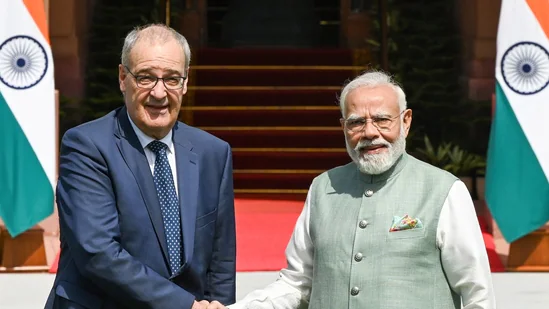
India and Switzerland have taken a significant step towards strengthening their bilateral relationship, Prime Minister Narendra Modi and Swiss Confederation President Guy Parmelin holding wide-ranging discussions on trade, investment, defence, nuclear energy, infrastructure, technology and people-to-people ties.
The two countries signed five agreements during President Parmelin’s visit to New Delhi, covering migration and mobility, young professionals, transportation technologies and infrastructure, scientific research, and innovation and technology transfer. The agreements are expected to provide fresh momentum to economic and strategic cooperation between the two countries.
The visit comes at an important time as India and the European Free Trade Association (EFTA)—comprising Switzerland, Norway, Iceland and Liechtenstein—mark the first anniversary of the implementation of their Trade and Economic Partnership Agreement (TEPA).
Trade and investment take centre stage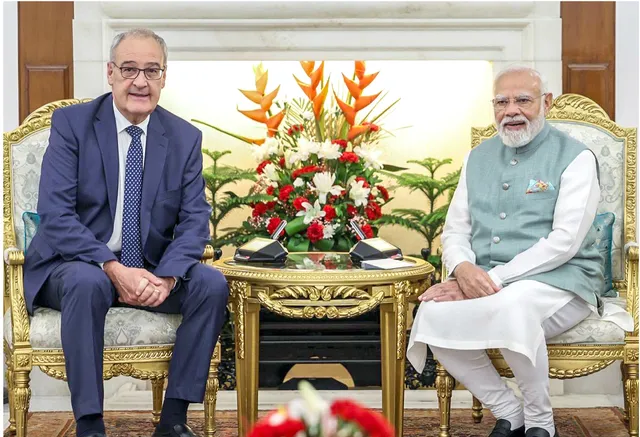
Trade and investment were among the key subjects discussed by Modi and Parmelin. Prime Minister Modi said India and Switzerland had taken several decisions aimed at expanding market access for Indian products and facilitating greater investment between the two countries.
The measures are expected to create opportunities for Indian exports in sectors such as agriculture, pharmaceuticals, textiles and engineering goods. At the same time, India wants to attract more Swiss investment into areas including biotechnology, life sciences, banking, insurance, food processing and sustainability.
The India-EFTA TEPA is central to these efforts. India has set an ambitious target of attracting $100 billion in investment over 15 years under the agreement, with the potential to generate around one million direct jobs in the country.
Switzerland has also expressed interest in concluding an investment protection agreement with India. President Parmelin emphasised that stronger protection for investments and progress on intellectual property issues would be important for creating a more predictable environment for businesses.
Defence cooperation gets a new push
Defence emerged as another important area of discussion.
Prime Minister Modi said India and Switzerland had identified new opportunities for cooperation in military exchanges and defence production. While India and Switzerland do not have a traditional defence partnership on the scale of India’s relationships with major military powers, the latest discussions indicate an effort to expand cooperation into new areas.
For India, collaboration with technologically advanced European partners can contribute to the country’s broader objective of strengthening domestic defence manufacturing and building reliable technology and supply chains.
The discussions also reflect India’s wider push to diversify its international defence partnerships while increasing domestic production capabilities.
Nuclear energy cooperation
The two leaders also agreed to deepen cooperation in the nuclear energy sector.
Modi said the two sides had reached a consensus on further strengthening collaboration in nuclear energy. The move comes as India seeks to expand its clean-energy capacity and reduce dependence on fossil fuels while meeting its long-term energy requirements.
Switzerland’s expertise in advanced technology, research and engineering could potentially contribute to India’s broader efforts in clean energy and advanced infrastructure.
However, the latest announcement should be viewed primarily as a decision to deepen cooperation rather than an immediate announcement of a specific nuclear power project.
Five agreements signed
The agreements signed during the visit cover several areas.
One of the most significant is the Migration and Mobility Partnership Agreement, which seeks to strengthen cooperation on legal migration while addressing irregular migration, human exploitation and trafficking.
The agreement provides for multiple-entry visas for up to five years, including stays of up to six months on each visit, as well as renewable one-year permits for students, according to India’s Ministry of External Affairs.
The two countries also signed a Young Professionals Agreement. It will facilitate exchanges of young professionals between India and Switzerland, initially covering 300 people annually from each country, with the possibility of increasing the number to 500.
Another agreement focuses on transportation technologies, mobility systems and infrastructure, with areas such as sustainable infrastructure, electric mobility, ropeways and tunnels expected to benefit.
The remaining agreements involve cooperation between research communities and collaboration in innovation, technology transfer and entrepreneurship.
Infrastructure and technology cooperation
Infrastructure is emerging as another important pillar of India-Switzerland ties. Switzerland has considerable expertise in railways, tunnels, mountain infrastructure and advanced transportation systems.
Prime Minister Modi invited Swiss infrastructure companies to invest more extensively in India and participate in capacity building, design and manufacturing.
India and Switzerland also plan to promote joint research in areas such as health, clean energy and space. Cooperation in science and technology is expected to become increasingly important as both countries seek to build innovation-driven economies.
President Droupadi Murmu, who also met President Parmelin, highlighted the potential for stronger cooperation in clean and green technology and artificial intelligence.
People-to-people ties
The agreements on migration and young professionals are expected to strengthen people-to-people connections.
Switzerland is home to a significant Indian community, including professionals, students and researchers. Easier mobility arrangements could create more opportunities for education, employment, research and professional exchange.
For Switzerland, stronger engagement with India’s large and rapidly growing economy offers access to a major market and a growing pool of skilled talent.
Wider global issues also discussed
The two leaders also exchanged views on international and regional developments, including the conflicts in Ukraine and West Asia.
Modi reiterated India’s support for dialogue and diplomacy and said India and Switzerland share a commitment to global peace and stability.
The discussions therefore extended beyond bilateral economic issues, reflecting the broader international dimensions of the India-Switzerland relationship.
Read more like this:
- Form 6 विवाद: CJI सूर्यकांत ने कहा- ‘किसी संशोधित Form 6 को सुप्रीम कोर्ट ने मंजूरी नहीं दी’, जानें पूरा मामला
- INDIA ब्लॉक ने CEC के खिलाफ निकाला विरोध मार्च, BJD के जुड़ने से विपक्षी एकजुटता को मिला नया बल
A partnership entering a new phase
The latest agreements indicate that India-Switzerland relations are expanding beyond traditional areas such as trade, tourism and finance. Defence, nuclear energy, advanced technology, infrastructure, research and mobility are increasingly becoming part of the bilateral agenda.
The first anniversary of the India-EFTA trade agreement has provided an additional opportunity to translate the framework of the pact into concrete investments, greater market access and job creation.
For India, the partnership offers access to Swiss capital, technology and expertise. For Switzerland, India’s expanding economy presents opportunities for trade, investment and long-term business growth.
The five agreements signed during President Parmelin’s visit could therefore mark the beginning of a broader phase of cooperation—one focused not only on commerce but also on technology, strategic cooperation, innovation and human mobility.
As both sides work to implement these agreements, their success will ultimately depend on how quickly commitments are converted into actual investments, projects, research collaborations and opportunities for citizens and businesses in both countries.