Join
Join
 Shorts

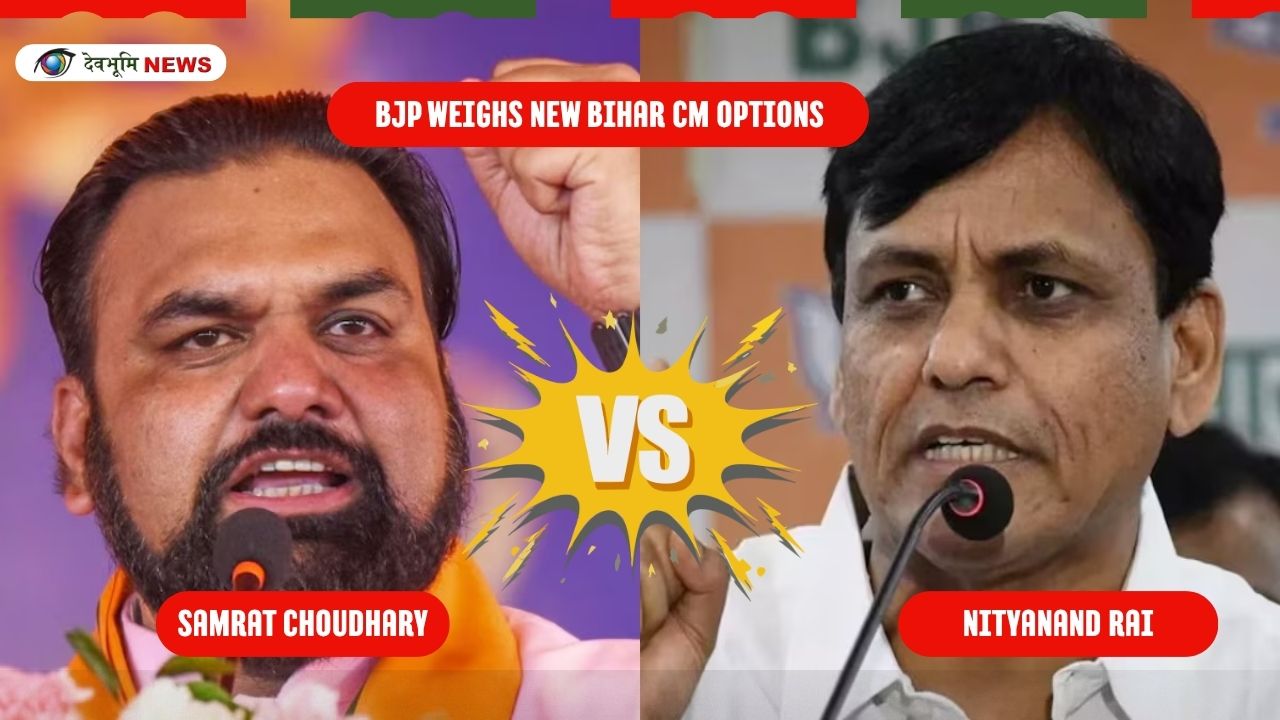
Samrat Choudhary and Nityanand Rai—who have been making significant headlines recently—are currently the frontrunners for the post of Bihar’s Chief Minister from the BJP, following Nitish Kumar.
The party is attempting to strike a balance between administrative experience, caste equations, and internal consensus—a development unfolding precisely as former Chief Minister Nitish Kumar took his oath today as a Member of the Rajya Sabha.
Political circles are currently abuzz with speculation that, based on subtle signals dropped by outgoing Chief Minister Nitish Kumar during recent public events, it appears that Choudhary could receive his unanimous backing as the consensus candidate should there be any shift in the existing alliance.
However, his path is not entirely free of hurdles. Choudhary’s past association with the Rashtriya Janata Dal (RJD) continues to sow seeds of doubt in the minds of some BJP cadres.
Periodic signs of internal dissent—such as opposition to posters projecting him as the Chief Ministerial face—indicate that the issue of factionalism within the party has not yet been fully resolved. In such a scenario, securing the unequivocal support of the central leadership becomes absolutely crucial for him.
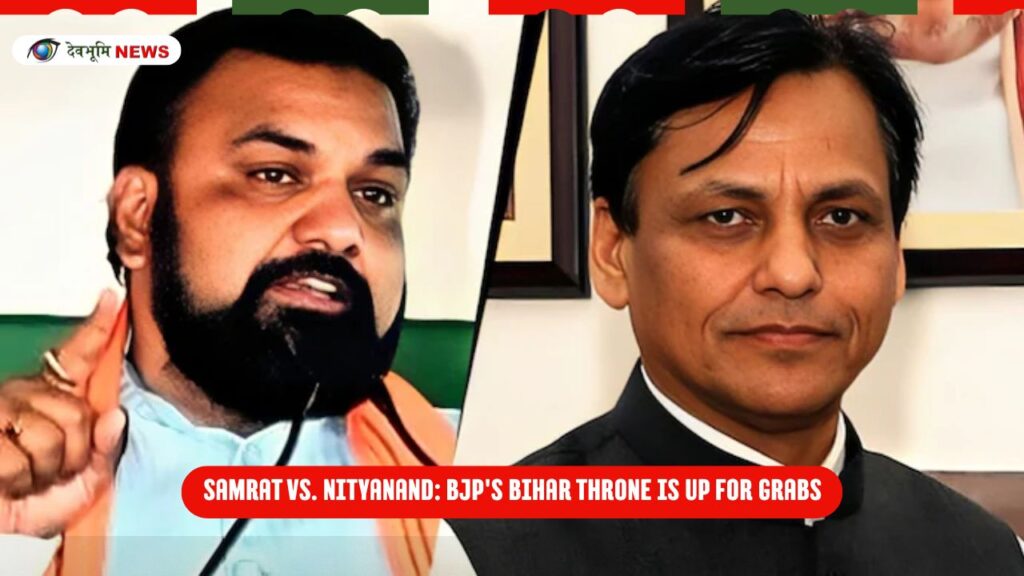
On the other hand, Nityanand Rai possesses deep organizational experience; furthermore, reports suggest that he enjoys a very close rapport with the BJP’s top leadership. A former President of the Bihar BJP, Rai is viewed as a leader with an exceptionally strong command at the grassroots level. His current role within the Union Ministry of Home Affairs further elevates his stature within the party hierarchy.
Arguably, his greatest political asset is his ‘Yadav‘ identity.
Given that this community has traditionally been a bastion of support for the RJD, the BJP could—as part of a calculated strategy—attempt to make inroads into this formidable vote bank by projecting a Yadav face. Should this occur, it could trigger a significant realignment in Bihar’s electoral landscape.
Nevertheless, Rai, too, faces his own set of challenges. Given his long-standing active involvement in national politics, Rai’s experience regarding the functioning of Bihar’s state administration is considerably less than that of Chaudhary. Leading a state government necessitates consistent engagement at the local level—an area where Rai appears to fall somewhat short.
The BJP also faces a strategic dilemma. In Bihar, the party’s electoral strategy has primarily centered on consolidating the support of non-Yadav OBC communities. Elevating a Yadav leader to the post of Chief Minister would be perceived as a significant departure from this long-standing strategy—a move that could potentially spark internal debate within the party.
Furthermore, given Rai’s current responsibilities within the central government, balancing his roles at both the national and state levels presents a complex challenge.
This broader political equation is not limited solely to these two candidates. The BJP recently decided to nominate another Kushwaha leader—Upendra Kushwaha—to the Rajya Sabha, despite his relatively modest political mass base.
This decision has raised the question: will the party once again place its bets on the same social demographic for the state’s highest office—that of the Chief Minister?
Concurrently, projecting Rai as a “Yadav face” could be part of a broader strategic design by the party. Ahead of the 2029 Lok Sabha elections, a potential elevation could help the BJP gain a foothold within Bihar’s Yadav vote bank, which accounts for approximately 14 percent of the electorate.
The ripple effects of this move could also be felt in the neighboring state of Uttar Pradesh, where this community remains the core support base for Samajwadi Party chief Akhilesh Yadav.
For the moment, the distinction is clear: Chaudhary represents administrative continuity within the existing political framework, whereas Rai symbolizes a calculated political maneuver aimed at reshaping the state’s caste dynamics.
Read also: