Join
Join
 Shorts

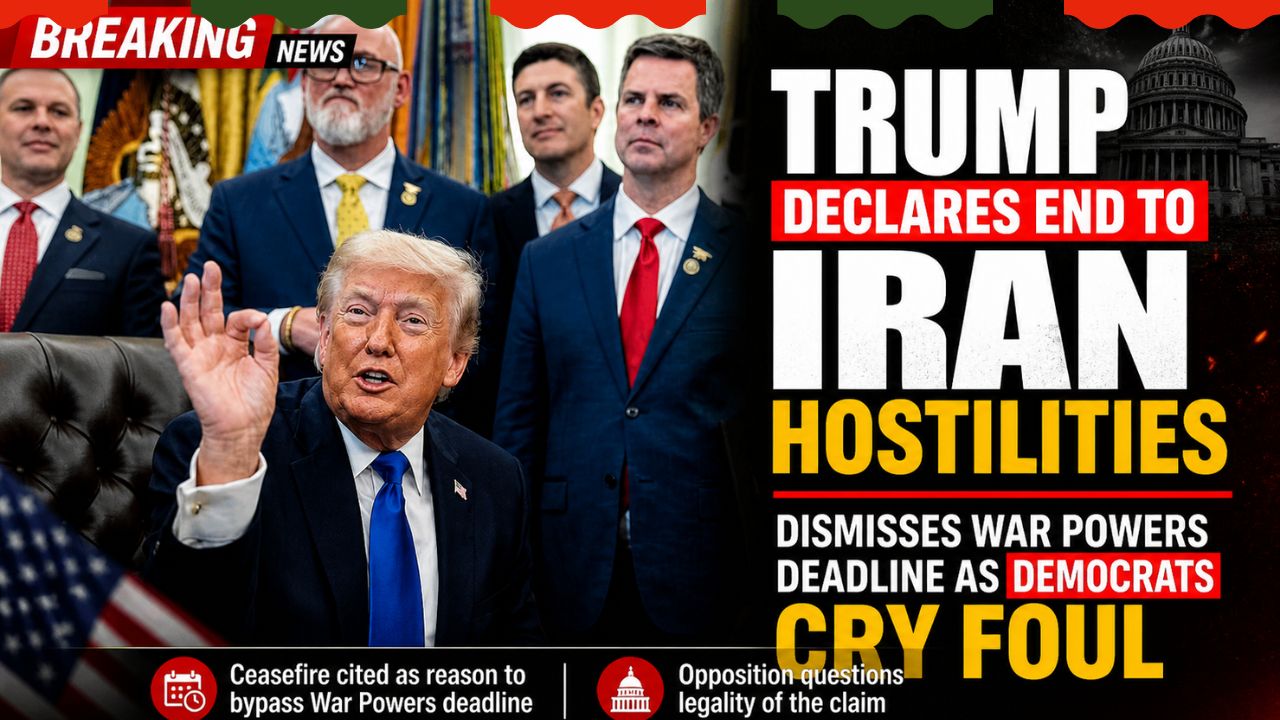
Trump Declares End to Iran Hostilities, Dismisses War Powers Deadline as Democrats Cry Foul: President Trump wrote to the leaders of Congress on Friday, claiming U.S. military hostilities with Iran are “terminated,” effectively sidestepping the legally important 60-day date under the War Powers Act of 1973.
The 60-Day Deadline and the War Powers Act
Friday was the 60th day since President Donald Trump notified Congress that the United States and Israel launched coordinated strikes against Iran on February 28, 2026, under the guise of Operation Epic Fury.
According to the War Powers Act of 1973, the president is able to use military force in the event of an imminent threat without congressional approval before deployment; however, he must seek the approval of the legislature within 60 days in order to carry on operations. The delay in obtaining this authorization legally will result in removal from U.S. forces.
What Trump Declares End to Iran Hostilities Letter Says
In a letter written on the 1st of May, 2026, that was addressed to House Speaker Mike Johnson and Senate President Chuck Grassley, the Senate President Pro Tempore, Trump argued that the deadline had been rescinded because hostilities had been terminated.
The letter says: “On April 7, 2026, I ordered a 2-week ceasefire. The ceasefire has since been extended. There has been no exchange of fire between United States forces and Iran since April 7, 2026. The hostilities that began on February 28, 2026, have terminated.”
Trump also informed his reporters in the White House on Friday that he did not intend to seek approval from Congress and argued that the War Powers Act was “totally unconstitutional” and was never enforced before its implementation.
“Nobody’s ever asked for it before. It’s never been used before. Why should we be different?” Trump declared.
Democrats Push Back Hard
Democratic leaders quickly rebuffed Trump’s assessment regarding the current situation.
Senate Minority Chairman Chuck Schumer said the claim was not true in a tweet on X. The conflict was described as “an illegal war” and accused Senate Republicans of being “complicit” while “lives are endangered, chaos erupts, and prices increase.”
Senator Jeanne Shaheen, ranking member of the Senate Armed Services Committee, declared that Trump’s statement does not reflect reality on the ground—pointing out that more than tens of thousands of thousands U.S. military personnel remain in the region, and the administration has repeatedly threatened to escalate as well as that the Strait of Hormuz remains closed which is a contributing factor to the increasing costs in the U.S.
“President Trump entered this war without a strategy and without legal authorization, and today’s announcement doesn’t change either fact,” Shaheen wrote.
Senator Adam Schiff of California, who was the sponsor of the latest War Powers resolution, said, “Even if you accept the premise that Trump’s war in Iran was responding to an imminent threat—which I certainly don’t—under the War Powers Act, he has no authority to continue this war past 60 days.”
Senate Blocks War Powers Resolution — Again
This week, Senate Republicans blocked yet another resolution on war powers proposed by Democrats, trying to officially stop U.S. military involvement in Iran. This was one of several resolutions that failed because of Republican opposition.
The Hegseth Argument: Does a Ceasefire Pause the Clock?
A day prior to the letter from Trump, the Secretary of Defense Pete Hegseth made a similar case in front of the Senate Armed Services Committee, declaring during a debate in a conversation with Senator Tim Kaine that “the 60-day clock pauses or stops in a ceasefire.”
Kaine was firm: “I do not believe the statute would support that,” declaring that the conduct of war raised “serious constitutional issues.”
Read Also: US-Israel-Iran War News: Ceasefire Pressures, Trump-Iran Talks & Strait of Hormuz Blockade
ACLU Warns of Illegal War
On Friday, on Friday, on Friday, the American Civil Liberties Union (ACLU) sent a letter to the White House expressing what it described as “profound concern” over what it called an illegal war being fought without authorization from Congress.
The ACLU claimed it was not clear that the War Powers Resolution contains no provisions for pauses or resets of the 60-day clock and argued that the administration’s legal arguments are fundamentally ineffective.
The War Is Not Over — By Trump’s Own Admission
While claiming that hostilities are “terminated,” Trump’s own letter admitted that the threat from Iran is still active.
“Despite the success of United States operations against the Iranian regime and continued efforts to secure a lasting peace, the threat posed by Iran to the United States and our armed forces remains significant,” Trump said and added that the Pentagon will keep updating the “force posture” across the region if needed.
Read Also: Starmer Says Polanski ‘Is Not Fit to Lead a Political Party’ After Golders Green Police Criticism
What Happens Next
With the majority of Republican lawmakers unwilling to confront this president’s authority, the 60-day timeframe is likely to expire without any intervention from Congress. Law experts and Democratic lawmakers warn that this creates a risky model for executive overreach in the realm of war—one that evades the constitutional responsibility of Congress when it comes to authorizing military action.
The fight about the War Powers Act, long believed to be ineffective in practice, is now at the heart of one of the most important constitutional disputes in recent U.S. political history.