Join
 Shorts

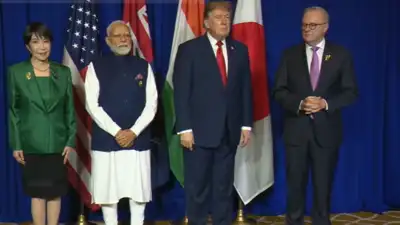
Manila Meeting Puts Regional Security in Focus
Prime Minister Narendra Modi’s participation in the ASEAN and East Asia summits in Manila has focused attention on Indo-Pacific security and renewed engagement among the Quad countries: India, the United States, Japan and Australia. Amid geopolitical uncertainty and maritime tensions, Modi is confident the grouping can help establish concrete goals for cooperation across the wider region.
The Philippines hosts ASEAN’s 2026 summit under the theme “Navigating Our Future, Together”. Modi attended the 23rd ASEAN-India Summit and is also taking part in the 21st East Asia Summit. The Quad meeting gives the four partners an opportunity to review cooperation and identify priorities.
Why the Quad Matters
The Quad is a diplomatic partnership, not a formal military alliance. Its members cooperate on maritime security, resilient supply chains, critical technologies, infrastructure, health security and disaster response. Its stated vision is a free, open, inclusive and rules-based Indo-Pacific.
The region contains major shipping routes. Disruptions at sea can affect energy supplies, commerce and the global economy. Cooperation on maritime awareness, safe navigation and capacity-building can help countries address shared challenges while respecting international law.
For India, the Quad complements its wider engagement with Southeast Asia. New Delhi argues that regional security should be inclusive and that ASEAN must remain central to the region’s architecture.
Maritime Security and Economic Resilience
Maritime security is expected to remain a central Quad priority. The partners have supported efforts to improve maritime domain awareness, share information and strengthen regional countries’ ability to monitor activity in surrounding waters. Coordination can help address illegal fishing, trafficking, piracy and threats to shipping.
Economic security is also gaining importance. The four countries are working to make supply chains more reliable, diversify access to critical minerals and strengthen cooperation in advanced technologies. These resources are essential for electronics, batteries, clean-energy systems and modern manufacturing. Coordination could reduce vulnerabilities and help economies withstand global disruptions.
Cooperation in artificial intelligence, semiconductors, cyber security and digital infrastructure can support innovation, but it also requires trusted networks, safeguards and skilled workers.
Modi Reaffirms India’s Commitment to ASEAN
At the ASEAN-India Summit, Modi said India and ASEAN should shape the future through cooperation rather than competition. He noted that the two sides together represent nearly one-fourth of the world’s population and share an interest in peace, stability and predictability.
He reaffirmed India’s commitment to ASEAN unity and centrality. He also highlighted the Act East Policy, which has expanded relations beyond shared culture and heritage into digital technology, defence and space.
Modi proposed a long-term maritime cooperation plan, joint cyber-forensics training, technical exchanges on nuclear energy, and collaboration in space and critical minerals. Other proposals included youth initiatives, more educational opportunities and free e-visas for tourists from ASEAN countries.
Disaster Management and People-to-People Links
India and ASEAN have agreed to deepen disaster-management cooperation through stronger early-warning systems, sharing satellite and weather data, joint preparedness exercises and faster humanitarian assistance. This matters in a region exposed to earthquakes, tsunamis, floods, cyclones, extreme heat and landslides.
People-to-people links are also central. Direct flights, tourism, scholarships and skill-development programmes can create opportunities for students, entrepreneurs and professionals. Modi said India had undertaken more than 100 initiatives to strengthen people-to-people ties, launched nearly 250 Quick Impact Projects and provided over 10,000 skill-development scholarships since 2014.
Read more like this:
- उत्तर प्रदेश की ड्राफ्ट मतदाता सूची जारी: सात महीने में 18.84 लाख वोटर्स बढ़े, 4 जनवरी 2027 को आएगी फाइनल लिस्ट
- Iran Planning Dirty Bomb Attack in Washington, US Intelligence Warns
The Road Ahead
The Quad’s value will be measured by results, not statements alone. Concrete goals need timelines, resources and regular follow-up. The partners must also respect the diverse priorities of Indo-Pacific countries and work with ASEAN-led institutions.
India must balance deeper strategic cooperation with its commitment to an inclusive regional order and its strategic autonomy. The Quad is one part of a broader diplomatic approach that includes ASEAN, the East Asia Summit and bilateral partnerships.
The Manila meetings matter beyond one leaders’ gathering. If India, the United States, Japan and Australia turn shared concerns into practical action, they can contribute to safer sea lanes, stronger economies and better preparedness for crises. Modi’s confidence in the Quad reflects India’s expectation that cooperation should deliver tangible benefits and keep the Indo-Pacific peaceful and stable.