Join
Join
 Shorts

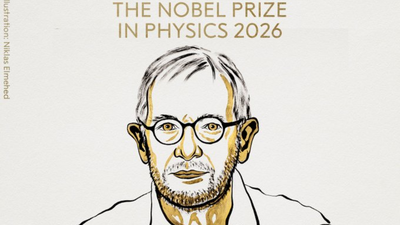
Belgian-American physicist Francis Halzen has been awarded the 2026 Nobel Prize in Physics for his decisive contribution to the IceCube Neutrino Observatory and the discovery of high-energy neutrinos of astrophysical origin. The Royal Swedish Academy of Sciences announced the award on October 6, recognising decades of scientific work that opened a new window into the most violent and energetic events in the universe.
Halzen, 82, is a professor at the University of Wisconsin–Madison and has been one of the central figures behind IceCube, an enormous neutrino detector embedded deep in the Antarctic ice. His work transformed an ambitious idea—using the South Pole’s frozen environment to detect elusive particles—into one of the world’s most important instruments for studying the universe.
A Nobel for studying the universe through ‘ghost particles’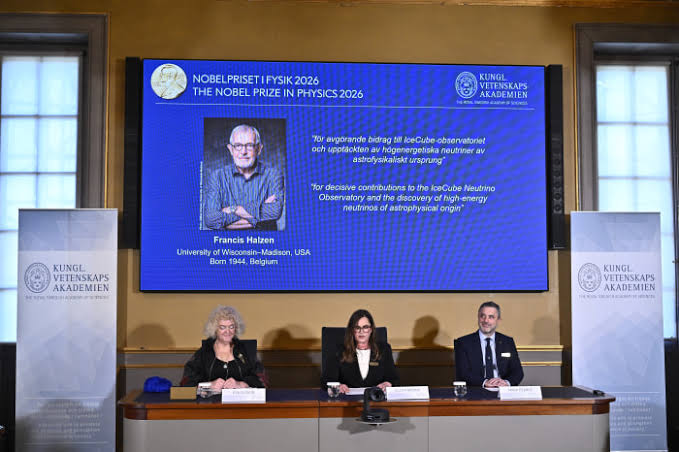
Neutrinos are among the most mysterious particles known to science. They have no electric charge and interact with matter extremely weakly. As a result, enormous numbers of neutrinos pass through Earth, buildings and even human bodies without leaving any detectable trace.
Because they rarely interact with matter, neutrinos are sometimes described as “ghost particles.” Their very ability to travel enormous distances without being significantly deflected or absorbed, however, makes them extraordinarily valuable to astronomers.
Unlike light, which can be blocked or altered by matter along its journey, neutrinos can escape extremely dense cosmic environments and reach Earth carrying information about where and how they were produced.
The Nobel Committee said these particles can provide information about violent cosmic environments and potentially reveal phenomena that conventional astronomical observations cannot fully explain.
Halzen’s revolutionary idea
Halzen’s key scientific insight was that the enormous quantity of transparent ice beneath the South Pole could be used as a detector.
When a high-energy neutrino happens to collide with an atomic nucleus in the ice, the interaction can produce a charged particle. That particle generates a faint flash of light, known as Cherenkov light, which can be detected by highly sensitive instruments.
The challenge was enormous. Neutrino interactions are exceptionally rare, meaning scientists needed a detector of extraordinary size.
Halzen’s vision ultimately led to the creation of IceCube, which uses roughly a cubic kilometre of Antarctic ice as its detection medium. Thousands of light sensors are positioned deep beneath the surface to record the tiny flashes produced by neutrino interactions.
IceCube opens a new form of astronomy
The IceCube Neutrino Observatory has fundamentally changed the way scientists can investigate the universe.
Traditional astronomy relies heavily on electromagnetic radiation such as visible light, radio waves, X-rays and gamma rays. Neutrino astronomy provides another type of messenger.
High-energy neutrinos can originate in some of the most extreme environments in space, including regions associated with black holes, exploding stars and other powerful cosmic processes. By studying their energy and direction, researchers can investigate the engines that accelerate particles to extraordinary energies.
The Nobel recognition therefore extends beyond particle physics. It also represents a major achievement for astrophysics and astronomy.
The Nobel Committee described Halzen’s work as paving the way for a new kind of astronomy, in which neutrinos can act as messengers from distant cosmic environments.
A project that faced scepticism
The development of IceCube was not straightforward. Building a gigantic scientific instrument in the Antarctic presented extraordinary logistical and technical challenges.
The detector had to be constructed deep beneath the ice, in one of the most remote and inhospitable environments on Earth. Scientists and engineers had to develop equipment capable of operating reliably under extreme conditions.
Halzen nevertheless continued to pursue the idea. His scientific vision helped bring together an international team of researchers and engineers.
The completed observatory was eventually able to collect the rare neutrino events needed to demonstrate the power of the technique.
The Nobel Committee highlighted Halzen’s persistence and scientific leadership as crucial elements behind the project’s success.
Why cosmic neutrinos matter
One of the biggest questions in modern astrophysics is how the universe accelerates particles to extremely high energies.
Cosmic rays have been known for more than a century, but identifying their sources and understanding the mechanisms that accelerate them has remained difficult.
Neutrinos can help solve this mystery because they are produced in high-energy particle interactions and travel in relatively straight paths from their sources.
IceCube’s observations have provided evidence that high-energy neutrinos originate from astrophysical sources, offering scientists a new way to investigate the universe’s most powerful accelerators.
Read more like this:
- ‘Revenge for Gaza’: What Flydubai Omani Co-Pilot Told Interrogators After Failed Attack
- CJP कार्यकर्ताओं को पुलिस नोटिस का दावा, अभिजीत दीपके बोले- 10 अक्टूबर का प्रदर्शन हिंसक हो सकता है
A milestone for science
The 2026 Physics Nobel marks the culmination of decades of research and international cooperation.
Halzen’s achievement demonstrates how a seemingly unconventional idea can eventually transform an entire scientific field. What began with the proposal to use Antarctic ice as a giant neutrino detector has developed into a powerful observatory capable of observing particles arriving from deep space.
The discovery also illustrates the importance of combining particle physics with astronomy. By studying neutrinos rather than relying only on light, researchers can explore cosmic environments that have remained hidden from conventional telescopes.
For Halzen, the Nobel Prize represents recognition of a lifetime spent pursuing one of physics’ most elusive particles.
For science as a whole, the award signals that neutrino astronomy is only beginning to reveal its potential. As IceCube and future observatories collect more data, scientists hope to identify additional cosmic neutrino sources and better understand the extreme processes that shape the universe.
The 2026 Nobel Prize in Physics therefore honours not just a detector or a single discovery, but a new way of observing the cosmos—through particles that can cross immense distances and carry messages from some of the universe’s most violent places.