Join
Join
 Shorts

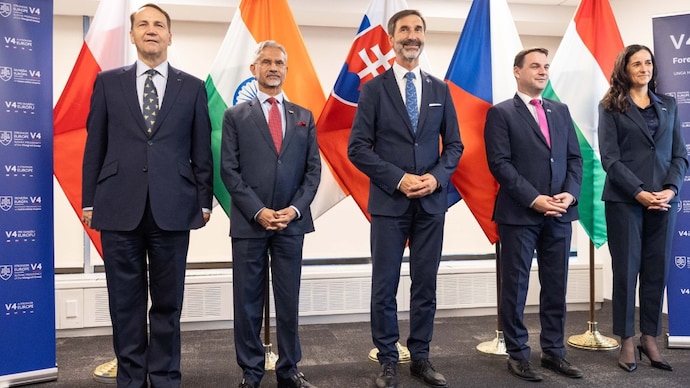
India’s campaign for a permanent seat on the United Nations Security Council has received fresh support from four Central European countries. Hungary, Poland, Slovakia and the Czech Republic have backed New Delhi’s demand, giving another boost to India’s long-running push for reform of the global body.
Four European Countries Back India
India’s demand for a permanent seat on the United Nations Security Council has gained fresh diplomatic support from the four members of the Visegrad Group, commonly known as V4. Hungary, Poland, Slovakia and the Czech Republic expressed support for India during the first V4-India foreign ministers’ meeting held on the sidelines of the 81st UN General Assembly in New York.
Slovak Foreign Minister Juraj Blanár said the four V4 countries agreed that India, as a major country of the Global South and an emerging power in the Indo-Pacific, should have a permanent place at the UN’s highest decision-making body.
The development gives India another bloc of European supporters as New Delhi continues its campaign for a more representative UN Security Council.
What Is the Visegrad Group?
The Visegrad Group consists of four Central European countries—Poland, Hungary, Slovakia and the Czech Republic. The grouping was established to promote cooperation among its members in political, economic, cultural, security and other areas.
The first high-level V4-India meeting marks a new institutional platform between India and the four Central European nations. External Affairs Minister S. Jaishankar described the meeting as a historic occasion and said India and the V4 countries would strengthen cooperation across multiple areas.
The two sides have also agreed to pursue regular foreign ministers’ meetings and an annual business forum, while expanding cooperation in areas including technology, defence and connectivity.
Why India Wants a Permanent UNSC Seat
India has long argued that the current structure of the Security Council does not adequately represent the contemporary international order.
The UN Security Council was established in 1945 and currently has 15 members—five permanent members and 10 non-permanent members. The permanent members are the United States, Russia, China, France and the United Kingdom. The five permanent members also possess veto power over substantive Council decisions.
India says the composition of the Council needs to reflect the changing political, economic and demographic realities of the world. Much of Asia and Africa was still under colonial rule when the current permanent-member structure was created.
New Delhi points to its large population, growing economic weight, diplomatic reach and contribution to UN peacekeeping as factors supporting its demand for a permanent role.
India has also served multiple terms as an elected, non-permanent member of the Security Council, most recently in 2021 and 2022.
Support From Other Major Powers
The latest backing from the V4 countries comes in addition to support India has received from several major powers.
France has consistently supported India’s permanent membership claim, while the United Kingdom and United States have also expressed support for India’s inclusion in an expanded Security Council. Russia has backed India’s bid as well.
India is also part of the G4 grouping with Brazil, Germany and Japan. The four countries support one another’s aspirations for permanent membership and advocate reform of the Security Council.
However, international support for India does not mean that there is agreement on every aspect of Security Council reform.
China Remains a Major Complication
One of the central challenges for India’s campaign is China’s position. China is the only current permanent member that has not explicitly backed India’s bid in the same manner as countries such as France, Russia, the UK and the US.
Security Council reform would require changes to the UN Charter and broad international agreement. The positions of the existing permanent members are therefore particularly important to any eventual restructuring of the Council.
Another unresolved question concerns veto powers. India has argued that if new permanent members are created, there should not be a separate category in which some permanent members possess veto rights while others do not.
India and the Global South
India has increasingly positioned its UNSC campaign as part of a broader demand for greater representation for developing and emerging countries.
Support from the V4 is significant in this context because the four countries have recognised India’s role in the Global South and the Indo-Pacific. The European backing also reflects growing engagement between India and Central Europe.
For New Delhi, the objective is not simply to secure a seat but to push for changes that would make the Security Council more representative of the contemporary international system.
What Happens Next?
The V4 endorsement strengthens India’s diplomatic case but does not automatically translate into permanent membership. Any expansion of the Security Council requires extensive negotiations among UN member states and agreement on issues such as the number of new seats, regional representation and veto rights.
India’s campaign is therefore likely to remain a long-term diplomatic effort involving negotiations with countries across different regions.
The latest V4 support provides another public endorsement of India’s position, while the wider reform debate continues at the United Nations.
Read more like this:
- नागरिकता से पहले वोटर लिस्ट में नाम? सोनिया गांधी के खिलाफ शिकायत फिर जिंदा, दिल्ली कोर्ट ने दिया नए सिरे से सुनवाई का आदेश
- बैंक स्ट्राइक 28-30 सितंबर: SBI ने जारी की एडवाइजरी, जानें कौन-कौन सी बैंकिंग सेवाएं रहेंगी चालू
Conclusion
The backing of Hungary, Poland, Slovakia and the Czech Republic marks a fresh development in India’s campaign for a permanent seat on the UN Security Council. The four Visegrad nations have publicly supported India’s claim, describing New Delhi as an important Global South country and an emerging Indo-Pacific power.
The endorsement adds to support India has already received from several major countries. However, Security Council reform remains a complex process, with disagreements over representation, veto powers and the structure of any expanded Council.
For India, the V4 support strengthens its diplomatic outreach in Europe while keeping the broader debate over reform of the United Nations’ most powerful security body firmly in focus.