Join
Join
 Shorts

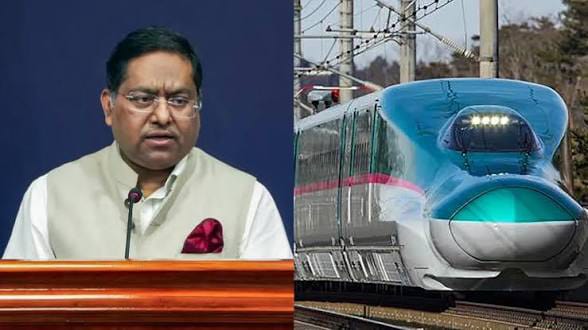
The Government of India has firmly rejected comments made by a former Japanese minister regarding delays in the ambitious Mumbai-Ahmedabad High-Speed Rail (MAHSR) project, popularly known as India’s first bullet train corridor.
The Ministry of External Affairs (MEA) described the remarks as “unwarranted and misplaced,” asserting that the project continues to make significant progress despite initial hurdles and remains a cornerstone of the India-Japan strategic partnership.
The response came after the former Japanese minister reportedly questioned the pace of the project and suggested that implementation delays reflected broader concerns regarding execution.
MEA Responds Strongly
Addressing the issue, MEA spokesperson Randhir Jaiswal said India does not agree with the observations made by the former Japanese minister.
According to the ministry, the remarks fail to take into account the extraordinary circumstances that affected the project’s timeline, including prolonged land acquisition challenges, the COVID-19 pandemic, legal procedures, and logistical disruptions
He stressed that the bullet train corridor represents much more than a transportation project, calling it a symbol of technological cooperation, mutual trust, and long-term strategic partnership between the two countries.
India & Background of the Shinkansen Project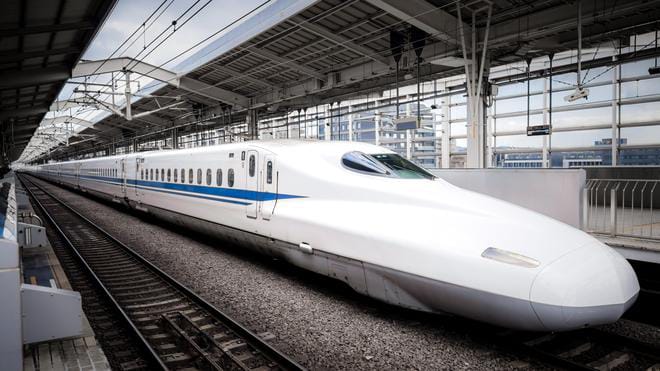
The Mumbai-Ahmedabad High-Speed Rail project was officially launched in September 2017 by Prime Minister Narendra Modi and then Japanese Prime Minister Shinzo Abe.
The project aims to introduce Japan’s world-renowned Shinkansen technology in India for the first time.
Once completed, the approximately 508-kilometre corridor will connect Mumbai in Maharashtra with Ahmedabad in Gujarat using high-speed trains capable of operating at speeds of up to 320 kilometres per hour.
The project is being executed by the National High Speed Rail Corporation Limited (NHSRCL) with significant financial and technical support from Japan.
Reasons Behind the Delay as India Confirms
Although initially expected to progress faster, the project encountered multiple challenges.
One of the biggest hurdles involved acquiring land across Maharashtra, Gujarat, and the Union Territory of Dadra and Nagar Haveli.Legal disputes, negotiations with landowners, and administrative procedures significantly slowed construction during the early years.
Construction Gains Momentum
Despite the delays, officials say construction activity has accelerated considerably over the past two years.
Large sections of the viaduct have already been completed, while multiple stations are at advanced stages of construction.Bridge works, track infrastructure, tunnel excavation, and depot development are progressing simultaneously across several locations.
Engineers are also working on India’s first undersea rail tunnel, a technically challenging component of the project that will pass beneath Thane Creek near Mumbai.
India’s Confidence in Completion
The Indian government has repeatedly reaffirmed its commitment to completing the project within the revised schedule.
Officials argue that mega infrastructure projects of this scale often experience delays due to technical, legal, and administrative challenges.
Importance of Japanese Partnership
Japan has played a crucial role in financing the bullet train project.The Japanese government extended a highly concessional loan with a very low interest rate and a long repayment period, making the project financially viable.
In addition to funding, Japan has also provided advanced railway technology, engineering expertise, and operational knowledge.
The Shinkansen system is globally recognised for its exceptional safety record, punctuality, and efficiency.
Strategic Significance Beyond Transportation
Experts believe the Mumbai-Ahmedabad High-Speed Rail project has importance far beyond passenger transport.
The corridor is viewed as a flagship symbol of India’s infrastructure modernisation and Japan’s long-term investment in India’s development.The project also strengthens the broader strategic partnership between the two Indo-Pacific countries.
Economic Benefits Expected for India
Economists believe the bullet train project could produce substantial economic benefits once operational.
Faster travel is expected to improve business connectivity between Mumbai and Ahmedabad, two of India’s most important commercial centres.The project may also encourage new industrial clusters, urban development, tourism, and investment along the route.
Construction itself has already generated employment opportunities across engineering, manufacturing, logistics, and infrastructure sectors.
Diplomatic Sensitivity
India’s strong response reflects the diplomatic importance attached to the project.
While the comments came from a former Japanese minister rather than the current government, New Delhi chose to publicly clarify its position to avoid any misunderstanding regarding bilateral cooperation.Officials stressed that both governments continue to enjoy excellent relations and remain committed to the project’s success.
Read more like this:
- Trump Alleges China Stole Data of 220 Million US Voters, Blames Beijing for Massive Cyber Theft
- DGMA Advises Shipping Companies to Avoid Deploying Indian Sailors on Vessels Passing Through Strait of Hormuz
- डिजिटल नोमैड क्या है, यह लाइफस्टाइल कैसे काम करती है और इसके क्या फायदे हैं? यहाँ पढ़िए पूरी रिपोर्ट-
Future Outlook
Construction is expected to intensify further in the coming months as civil works advance across multiple sections.
Authorities are continuing work on stations, bridges, tunnels, track laying, signalling systems, and rolling stock infrastructure.
Training programmes for future high-speed rail personnel are also progressing with Japanese assistance.
Officials remain optimistic that the first operational sections of the corridor will demonstrate the project’s potential and pave the way for future high-speed rail networks in other parts of India
Conclusion
India has categorically rejected the remarks made by a former Japanese minister regarding delays in the Mumbai-Ahmedabad Shinkansen project, describing the criticism as unjustified and failing to acknowledge the unprecedented challenges faced during implementation.
The Ministry of External Affairs has reaffirmed that both India and Japan remain fully committed to completing the country’s first bullet train corridor, which continues to make steady progress after overcoming major land acquisition and pandemic-related obstacles.
Beyond being a transport initiative, the Mumbai-Ahmedabad High-Speed Rail project represents a landmark partnership between two trusted strategic allies.
With construction accelerating and bilateral cooperation remaining strong, officials believe the project will eventually reshape India’s transportation landscape while further strengthening the enduring relationship between New Delhi and Tokyo.